DAD-O-GRAM
A Dionysian Trip to
Bacchus-Land
Alsace and the Rhine and Mosel
Rivers
1996
Dear Cha-Wel-Dor-Sue:
 A
previous and delightful trip to Bordeaux, France (a red wine trip)
with Vin Mattaroli's "Lovers of Wine" group prompted Pat and me to
sign up for another wine venture, this time to discover the white
wines of Alsace, France, and the Mosel and Rhine River areas of
southeastern Germany.
A
previous and delightful trip to Bordeaux, France (a red wine trip)
with Vin Mattaroli's "Lovers of Wine" group prompted Pat and me to
sign up for another wine venture, this time to discover the white
wines of Alsace, France, and the Mosel and Rhine River areas of
southeastern Germany.
Our
group was small (14) and we traveled by bus to our various bases and
to the many vineyards where we enjoyed "tastings". Most of our meals
were "gourmet" and specially prepared for us with a careful selection
of appropriate wines to accompany each course. Our traveling
companions were all oenophiles who enjoyed analyzing the various
constituents and characteristics of each wine and who made notes so
that they could share them with their wine lovers at home. Most of us
brought home a bottle or two of our favorites from those
tastings.
Most
of the group flew Icelandic Air to Luxembourg, where we all gathered
together to board our bus, which drove us southeast through Metz, and
Nancy, to Colmar in the Alsace Lorraine section of France. It was our
headquarters for three days. Everyone enjoyed walking through
Colmar's narrow streets with its colorful half-timbered houses,
ancient churches, unique public buildings, and shops of all kinds.
Frankly, Colmar appeared more German than French, and I presume this
is due to the fact that a large part of its history occurred while it
was occupied by the Germans.
Our
first vineyard visited was the Maison Mure in Rouffach and our second
to the Maison Charles Schleret in Tuckheim. In between, we visited
the Wolfberger Distillery, famous for its distillates, or fruit
brandies. These products are distillates of crushed fruits and are
not identical with cordials or liquors, many of which are made by
soaking fruits in alcohol.
Unlike
our trip to France, where we visited many vineyards, we, on this
occasion, spent virtually our entire mornings and afternoons tasting
many more wines at one source and listening in detail to the
proprietors discussing the special features and characteristics of
each of their wines.
Alsace is noted for its seven varietal grapes and
these may be summarized as follows:
1. Sylvaner
a light wine, fresh and fruity.
Delightful with sea-food, fish and charcuterie.
2. Riesling
Alsace wine "par excellence", full of
character, with a delicate bouquet and an exquisite fruitiness.
It compliments the finest food and is superb with fish,
shell-fish, sea-food and, of course, choucroute
(sauerkraut).
3. Gewurtztraminer
elegant, full-bodied and
well-balanced, it is a wine with a highly elegant bouquet,
which has an appealing taste and smell.
4. Muscat d'Alsace
a dry wine, with a distinctive
bouquet. It is a delicious aperitif and an incomparable wine
for parties and receptions.
5. Pinot blanc or Klevner
a well-balanced, subtle yet lively
wine. Can be served wherever white wine is called for.
6. Tokay Pinot gris
a heady, rich and full-bodied wine. It
enhances all rich foods, particularly foie gras and juicy roast
meats. It too is a high quality aperitif.
7. Pinot noir or Rose d'Alsace
a dry rose-wine, with a delicious
fragrance. Charming and original.
On
our second day, we spent half the morning at the Maison Sparr in
Sigolsheim and the other half at the Maison Hugel in Riquewihr.
Throughout this area, there are numerous wine states and each located
in small picturesque medieval towns, all worthy of more lengthy
visits. In the afternoon, we drove to Strasbourg for an afternoon on
our own. Though we have been there twice, we have not as yet seen it
at its best or to our complete satisfaction.
Mainz
served as our second headquarters and this is an interesting city.
Early in Mainz's history, it was an archbishopric and was the only
part, apart from Rome, to be granted the name "Holy See" and Catholic
priests ruled the city until 1792, when it became a republic. After a
brief city tour, we were taken to the Gutenberg Museum, where movable
metal type was first employed and the first bible was printed. The
museum is extraordinary and contains a variety of all the earliest
type of printing presses and is probably unequaled in the world in
this regard. From Mainz, we visited the general area of the Rheingau
and specifically the vineyards of Kloster Eberbach and Schloss
Johannisberg, both well-known and famous. On our second day, we
visited the Rheinhessen area and the wine estates of Guntrum in
Nierstein and the Fritz Bastian Winery in Bacherach.
Between
these visits, we enjoyed a two hour cruise on the Rhine from Bingen
to St. Goar, and that evening, we enjoyed dinner at
Rudesheim.
On
our trip from Mainz to Trier, we stopped at the Kloster Machern for a
tour of this winery and a delightful lunch. This site is an old
abbey, beautifully restored, that today is the site of music concerts
and art exhibits.
Trier
is the oldest city in Germany and it is said antedates Rome by at
least several hundred years. In 16 BC, Emperor Augustus established a
city here called Treverorum after the Treveri, a Celtic people that
inhabited this area. It has been successfully occupied by the Romans,
Franks, French and Germans and today is a university city and
cultural center. The Roman ruins, especially the imperial Baths, the
Amphitheater, the Porta Nigre, or Black City Gate, and the Roman
Bridge are all well-preserved. The Cathedral (Dom), Town Hall, Roman
Basilica, and the Karl Marx House were all of special interest. Trier
was selected as our home base in order for us to see and visit the
many vineyards along the Mosel and Saar rivers. The slopes of each of
these rivers are lined with vineyards, some with inclines of 60
degrees and almost impossible to ascend. Never have I seen such a
dense concentration of wine plants and such picturesque old
villages!
After
our group departed for home from Luxembourg, Pat and I remained in
Germany for another five more days, spending three days on the Mosel
(Bern Castle, Cochem, and Koblenz), and our final two days in
Frankfurt.
It
has been said that a day without wine is like a day without the sun,
and one man describing the merits of a famous Sauterne (Chateau
d'Yquem, 1921) said that "You can place a glassful under the nose of
a dead man, and he will revive immediately, with a smile on his face,
drink down the luscious nectar and then lapse into an eternal sleep,
filled with dreams of all that is pleasant." What a good reason for a
Dionysian journey!
A
few general and specific remarks about wine at this time may be of
some interest to you. Wine, as everyone knows, results naturally when
grape juice is permitted to ferment and the yeast in the skin of the
grape converts the sugar into alcohol and carbon dioxide gas. All
that is needed is for the skin of the grape to be broken and nature
will do the rest providing normal temperatures prevail. Usually,
under normal conditions, fermentation will go on until all the sugar
is converted into alcohol or until the alcohol reaches 15 %, which
overcomes the yeast and fermentation ceases. All wines would be
colorless unless the skin is left in contact with the juice during
fermentation (Roses - 3 days, Reds - 7 days on an average). There
resides in all grapes an unresolved complex of principles: of acids
and sugars, minerals and pigments, esters and aldehydes, and tannins,
and these are responsible for the taste, aroma, bouquet, body and
fullness of the wines. The great enemy of wine is oxygen and Louis
Pasteur discovered this when asked by Napoleon 111 in 1863 to find
out why wine went bad. He discovered that too much contact with air
encourages the growth of vinegar bacteria, but also noted that a
little oxygen encourages the maturation of wine. Robards "Book of
Wine" notes "Without question, Germany is the greatest white
wine-producing country in the world and the cultivation of the grape
here is superior in terms of quality if not quantity. Skill,
craftsmanship and perseverance contribute to the greatness of the
wines of the Rhine, Mosel, Ruwar and Saar areas. The sweetness of the
great Rhine and Mosel wines is entirely natural, much as the same
sweetness exists in a ripe peach, and all of the good German wines
are harvested late in the autumn, allowing the water in the grape to
evaporate through the skin, leaving a concentrated nectar within the
grape. Under ideal conditions, the grapes will contract a mold or
fungus called "Botrytis Cinerea" or "Noble Rot". The mold digs into
the skin without breaking it and thus contributes to the evaporation
of the water and the grape."
The
nomenclature, or terminology, used to describe German wines has
always been confusing. In short, the quality of German wines relates
to the degree of residual sugar or sweetness, and this is basically
achieved by late harvesting. "Spatlese" refers to the late-picked
grapes. "Auslese" means selected, late-picked bunches of grapes.
"Beerenauslese" means each grape is harvested individually after it
has begun to turn into a dried berry. "Trockenbeerenauslese" refers
to wine made after the berries have shriveled and produced the most
concentrated juice of all, often with the help of the "Noble Rot".
"Eiswein" is made from grapes that have already frozen. It is
interesting historically that a group of monks, years ago, were late
in receiving their license to make wine and had to do so after the
grapes were harvested very late and had already been infected with
the "Noble Rot" and far from being disappointed with the results,
they discovered, to their surprise, the extraordinary sweetness of
their product.
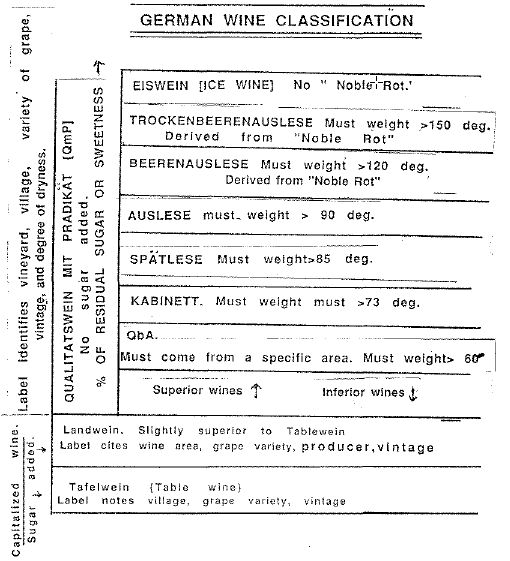
At
our initial meeting on our tour, we heard from the head of the German
Wine Academy and we were shown a chart (see attached chart)
indicating the various categories or classifications of German wines.
As you can see, the lowest quality is that of Tafelwein, or Table
wine, and this type of wine can be "Capitalized" or a wine to which
sugar may be added. "Landwein" is a slightly better wine in quality
and can also be capitalized. All wines above this level are
"Qualitatswein", to which no sugar may be added. They must be
produced from approved grape varieties and from government-approved
areas and must attain 8.5% of alcohol. Those called "Kabinett" or
wines worthy of being stored in a cabinet, are quality wines. The
highest quality of wines are called "Qualitatswein Mit Pradikat", or
with special attributes. This means that they contain at least 10%
alcohol and contain increasing percentages of residual sugar,
ascending from the level of "Spatlese" to "Trockenbeerenauslese".
Sweet wines are not dry wines because they contain less acid. For my
palate, a more harmonious wine is one with less acid and more
sweetness. One often sees the words "Halb Trochen" on a wine label,
and this means half-dry.
All
German wines must list on its labels the name of the village, town,
commune or regional area where it was produced, the vineyard within
the town, if the wine is of an unusual quality, the name of the grape
from which the wine was made and lastly, the year of its
vintage.
Wine
has been known virtually since the dawn of civilization and from its
history, we can gather that its earliest uses were for medicinal
purposes and ritual or sacramental uses. In Simon's book entitled
"Wines of the World", the first paragraph of the introduction reads
as follows: "Wine is as old as the thirst of man, not the physical
thirst which man can so easily slake with water, as his horse and dog
do, but the heaven-sent thirst for what will still our fears - that
our mind be at peace; and stir our sense and sensibility - that we
shall not ignore nor abuse God's good gifts - wine not the least of
them."
According
to Pickett's "Origines Europeene", wine-making was introduced by the
Aryans in India, Egypt and Persia and scenes of grapes being picked
and pressed are in the Tomb of PhtahHotep, who lived in Memphis some
4000 years BC. Among the laws of Hamarabi, who was King of Babylon in
about 1790 BC, regulations are mentioned dealing with the marketing
of wine. It was noted that if a Taverner "overcharged, sold bad wine
for good, or allowed riotous conduct on his premises, and was
convicted, penalties were not fines or prison, but the loss of limb
or of life!''
The
Phoenicians, Greeks and Romans cultivated vineyards and carried them
northward across Gaul and into the valleys of the Rhine and Danube.
At one time, the vineyards were so numerous throughout these areas
and wine so abundant, that Domitian ordered all trans-Alpine
vineyards to be destroyed! Today, wine is made all over the world
where temperate climates prevail.
It
might be noted at this point that French wines are labeled according
to the area in which they are produced and each area has its own
standards and regulations. In Bordeaux, where we were three years
ago, the wines are roughly classified into three groups:
(A) AC or Appellations Controlees, which
are guaranteed not only or origin but of a standard administered
by the Institute National des Appellations d'Origin.
(B) BDQS, Vin Delimited de Qualite
Supeieure.
(C) Vins de Pays (table or house
wines).
The institute divides the vineyards into four
classes or ranks:
1. Grand Crus, or first class.
2. Premier Crus, using the name of the commune
or parish, and the name of the vineyard.
3. Appellation Communale.
4. The lowest rank, usually only named after
the parish in which it is produced.
The wines produced in Burgundy, Beaume, Chablis,
Cote de Rhone, etc., all have their own specific regulations for
labeling.
It is interesting that here in the United States
of America, wines are advertised as generic or varietal:
(A) Generic wines are wines named after
the famous wines of the various European districts such as
Chablis, Burgundy, Rhine, and Sauterne, etc.
(B) Varietal wines, which are named after the
grape variety, such as Cabernet Sauvignon, Chardonnay, Pinot Noir,
Riesling and Gewurztraminer, etc. To be called a varietal wine, at
least 51% of the grapes must be of that variety.
Many
of our popular wines are blended wines. An analogy occurs in
Scotland, where there are far more blended scotches than there are
single malts.
The
wines of Spain, Portugal, Italy, Chile, Argentina, Australia, South
Africa, etc., all have their own terminology. For instance, in
Australia, it's "Claret" is really a red Bordeaux-like wine. Some
day, it occurs to me, it would be ideal if a standardized labeling
system could be developed, indicating the variety of grape or grapes
used in the wine, the name of the country, village, commune or
chateau from which it was produced, the year of the vintage, the
degree of acidity (tannin) or dryness, the percentage of residual
sugar (sweetness), the alcoholic content, the negotiant or blender,
and the color (white, rose or red). in this manner, it would be far
simpler for one to purchase a bottle of wine and know truly what they
were buying.
Lastly,
I should add that I was first introduced to wine as an acolyte, as I
served in St. Peter's Church in Perth Amboy, New Jersey, during
communion services (1924).
With love,
Dad
1996
Below is a wine chart I created:
Return to Charlie's
Web Page
or
E-mail Charlie at
cejjrmd@mac.com