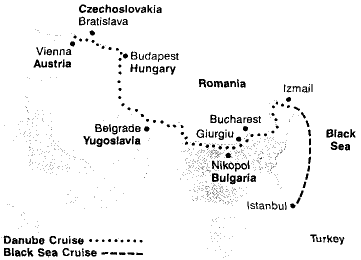
Danube River Adventure
Istanbul-Vienna 1986
Dear Cha-Wel-Dor-Sue,
 It
has been said that in life, the important thing is the "journey", and
not the destination, for in the end, that is death; welcomed by some
and dreaded by the majority.
It
has been said that in life, the important thing is the "journey", and
not the destination, for in the end, that is death; welcomed by some
and dreaded by the majority.
In
our Danube adventure, neither the origin of our trip (Istanbul) nor
our destination (Vienna) were important to me but rather, it was the
"journey". On this trip, we were to traverse the Black Sea on the
M.S. Ayvazovskiy and then enter the most eastern and northern access
in the Danube Delta and cruise up this river as far as Ismail
(U.S.S.R.), where we were to be transferred to our Danube River Boat,
the M.S. Ukraina, for the trip up the Danube River. We were not to
touch the soil of the U.S.S.R. Further up the Danube, we were to have
the experience of passing through the so-called "Iron Gate" with its
locks and then would subsequently pass through and by five countries
in the so-called Eastern Sector, i.e., Rumania, Bulgaria, Yugoslavia,
Hungary, Czechoslovakia and Austria, terminating in the city of
Vienna. I am sure that for Pat, Vienna is the beginning and end of
all the great cities in Europe and I suppose this is understandable,
as she lived in Austria for approximately 15 months (12 months in
Salzburg and three months in Vienna) during her spell with the Armed
Services in Europe.
Istanbul
is always exciting to me for it is the only city in the world
situated on two continents (Europe and Asia). The city was called
Byzantium under Roman rule, Constantinople after the city was
Christianized under Constantine, and Istanbul during the reign of the
Ottoman Empire. Finally, the city, in 1923, became part of the
Republic of Turkey, or Anatolia, under the presidency of
Attaturk.
There
are six million people living in the city of Istanbul which is
situated on both sides of the Bosphorus which connects the Sea of
Marmaraon the south with the Black Sea on the north. The Sea of
Marmara enters the Mediterranean Sea through a narrow strait called
the Dardenelles.
On
our previous trip, we visited all the major historic sites and
mosques but failed to see the Dolmapahce Palace, the reigning
Sultan's palace for about 100 years and situated on the Bosphorus. It
was closed for renovations on our previous visit and we did not have
the opportunity to see this most unusual and beautiful building. On
this occasion, it was open, including the Harem Section and I truly
believe it rivals Versailles for its magnificence and opulence. We
spent an hour and a half marveling at the beauty of the various rooms
and the furniture and decorations, most of which were contributed by
the crown heads of Europe and Asia. It is of interest that there were
no gifts from the U.S.A.!
Pat
and I also spent no little time in the Grand Covered Bazaar, and I
could have spent more than the five hours wandering throughout the
vast maze of shops and streets. It is far better organized than the
El Klalil Bazaar in Cairo, the Casbah in Tangiers or the largest one
in the world in Addis Abbaba. We did a little shopping but mostly
reveled in looking at the various arts and crafts of the Turkish
people.
After
paying a last minute visit to the "Gallata Tower", which is situated
on the highest point in the old town, and which provides the best
panoramic view of the city and of the "Golden Horn" or inlet which
divides the old and the new cities, we departed on the Russian Ship
for our cruise across the Black Sea to the Danube Delta. This was a
late afternoon and evening cruise and we arrived on the following
morning at Ismail, which is part of the U.S.S.R. In the morning of
our arrival, we had the first of our cultural lectures, and he began
to lecture just as we were entering the north access tributary of the
Danube River. Apparently, the Danube Delta is much like the
Mississippi Delta in that there are many accesses to the sea and in
the Danube Delta particularly, two of the major accesses lie in
Rumania and the third, or the one that we took, is situated in
Russia. Apparently, this portion of the Danube Delta was formerly a
part of Rumania but like many other things, was absorbed by Russia
after World War II. In securing this territory, it provided them
access to the Danube River and enabled them to create a virtually
monopoly on the river. While all of the other countries through which
the Danube passes through or by have their own shipping interests,
the U.S.S.R. Danube River Shipping Company certainly is the most
important of the shipping companies.
The
Danube River in the Delta area appeared to be alive with shipping
with many oil tankers, coal and iron ore barges, some grain boats and
many barges and dredges pushed by massive tugboats. There were very
few sizable passenger vessels but there were many hydrofoils, many of
which served as ferries which transported people up and down and
across the river. All along the river are forests with innumerable
well-spaced and precisely planted poplar trees which apparently were
designed both as tree farms and to hold the bank against water
erosion. There were occasional vineyards and fruit orchards and
everything appeared to be a very lush green and most attractive. In
order to visit Bucharest, it was necessary for us to dock at
Oltenita. Following lunch on the boat, we drove by bus to Bucharest
for a city tour, dinner, and Folklorica Show, returning to the Danube
at the city of Giurgiu. While in this area, it was interesting to
look to our left and see Bulgaria, while looking to the right, we
would be looking at Rumania. Bucharest was our first optional tour
and while the city has been called the "Paris of the Balkans", it is
no longer the attractive city that we visited eight years ago. The
streets are all torn up by subway construction and all of the suburbs
are typical Russian apartment type construction. Previously, we had
spent four days here, including a day's flight to Kiev, Russia, but
on this occasion, we had a bus ride of approximately one hour to and
from the Danube to reach the capital and a brief city tour. The
former enchantment is gone and Rumania will always be a thing of the
past as far as Pat and I are concerned. We revisited the Village
Museum and had dinner and entertainment at the Intercontinental Hotel
where we had been housed on our previous visit to the city. Tomorrow
would be Bulgaria, the home of the perennial Olympic weight-lifting
champions and the country most closely aligned to the
U.S.S.R.
Bulgaria,
at this point, is one of the highlights of our trip for the
countryside is rural and is intensively developed agriculturally, and
the few people we met appeared to be friendly and smiled a great
deal. We visited the sixth largest city in Bulgaria, Pleven, a city
famous in Bulgarian history, for it was here that the combined
Bulgarian and Russian troops defeated the Turks in 1876. There is a
large diorama situated on a high hill which depicts the battle and is
most impressive. On the Hundredth Anniversary of the battle, the city
rebuilt its entire central portion and created a beautiful park with
innumerable fountains. This will always commemorate its liberation
from the Ottoman yoke. We visited an Icon Museum and had lunch and
various wines and brandies in a cave restaurant. Everyone left
Bulgaria impressed with the country and the intense pride their
peoples had in their heritage. It is now understandable to me why
Bulgaria is so closely attached and identified to the U.S.S.R. and
why they are prosecuting the Turkish minority which live in the
southern half of the country. Apparently, at this time, they are
practicing Stalinist genocide in an effort to remove all of the Turks
from this part of the country. The Turks are having to change their
names and to change their religions and their refusal to do so is
tantamount to execution.
Our
fourth day on the Danube was spent on the river with no shore
excursions. Once again, it was a beautiful day and afforded us a
great opportunity to see and compare the north bank Rumania with the
south bank Bulgaria. There were many farms, small villages and some
riverboat activity. Later in the day, at the point where Rumania and
Yugoslavia more or less meet, we passed through the Djerdap Dam,
which was built some 20 or so odd years ago and which served to raise
the ship approximately 60 to 70 feet in two successive locks. This
dam was built not only to provide hydroelectric power but also to
raise the water level in the area above the dam to eliminate the most
treacherous part of the Danube River known as the Iron Gate. This
stretch of the river is approximately 120 kilometers in length and
was formerly the most treacherous part of the river, with high
cliffs, speedy rapids, and extremely strong currents which made
travel in either direction difficult and unsafe. The dam created
something of a lake 120 kilometers long and inundated many small
villages which had been built on the river's edge. Thousands of
homesteads had to be displaced. It succeeded, however, in making
water travel safe and feasible in this area and has enhanced cargo
traffic and tourism. It is interesting that a Roman Plaque had to be
raised some 30 feet in height in order to preserve it, much as was
done at Abu Simbel on the Nile above the Aswan Dam.
Still
later in the day, we stopped at the Yugoslavian checkpoint and had
our passports inspected. No search of any kind was carried out in our
cabins. We were at the dock for one hour awaiting the arrival of the
Yugoslavian Customs and Immigration officials, and the reason given
for the delay was that the Yugoslavians have no great love for the
Russians, in contrast to that of the Bulgarians. The Russian crew of
our ship had to dock the ship with no assistance whatsoever from the
dock crew at the wharf, such as occurred while docking in Bulgaria.
The Yugoslavs and the Russians are not friendly, though both are
Socialists in their political philosophy. As you may recall, it was
Tito who defied Stalin and established his own brand of
Communism.
Some
365 miles of the Danube River courses through Yugoslavia, including
some of the most varied and colorful sections of the river. Its
capital, Belgrade, or Beograd, is a dynamic, modern capital with a
population of 750,000. Yugoslavia is one country, with two dialects
(Cyrillic and Latin).
Bulgaria
has been a cross-roads between the East (Orient) and the West and has
been the scene of countless battles, being totally destroyed many
times. Like Warsaw, it has had more blood spilled there than in any
other of the cities in Europe.
Yugoslavia
is governed by the Communist Party and is not in the Warsaw Pact.
They call themselves Socialists and the state is tolerant of
religion, linguistic diversity and a degree of local autonomy. One
third of the country is agricultural and the rest is engaged in urban
industry. The different ethnic groups have a powerful folk tradition
and they are great lovers of sports, especially soccer and
basketball.
Belgrade
is interesting in that it has existed for 2,300 years and has been
totally destroyed 47 times. During the reign of the Ottoman Sultans,
there were over 200 mosques in this city. Today, there are none, and
the only relic of Islam is a small mausoleum containing the remains
of the last Turkish general who lost his life in the final battle for
control of the city. It is a twin city like Budapest, with the old
city on one side of the Save River and the new city on the other
side. The oldest buildings are only 150 to 200 years old and all are
centralized in the old city. We enjoyed a city tour in the morning
and chose to shop along the shopping street in the afternoon. In the
evening, we went to a street that has been set apart as an
entertainment area and there we were treated to and enjoyed a typical
Yugoslavian dinner and accompanying musical entertainment.
At
this moment, Yugoslavia appears to have many problems: 1) A foreign
debt of 20 billion dollars. 2) Inflation of 85 to 100% per year. 3)
Unemployment of 15-20%. 4) The problem of nationalization which tends
to divide the country. It is only the strong army that keeps the
various diverse groups acting together as a viable government. The
Albanians in the south constitute a constant thorn on their southern
exposure.
Our
guest lecturer, Dr. David Griffiths, Professor of Eastern European
Studies at the University of North Carolina at Chapel Hill, has been
a most stimulating and informative teacher to this point and one who
has told us all about the history, the economy, the political
structure, and the geopolitical alignments of all of the countries we
have passed through. He certainly is among the very best of all of
the lectures that we have ever heard previously on any of our
trips.
After
leaving Belgrade, we spent another entire day on the river, without
any shore excursions, as it is a long trip to Budapest, Hungary. Once
again, we enjoyed a beautiful, sunny day, and I found myself falling
in love with this beautiful river. One is endlessly fascinated by the
scenes on the shore, varying from simple natural forests to managed
forests, to cultivated fields of grain and maize and sun-flowers, to
little villages with their churches, to towns of varying sizes, and
finally, to the sparse river traffic, so unlike the Rhine. Given good
weather, a trip of this kind is indeed a memorable
experience!
The
group who sailed down the Danube the previous week were less
fortunate than us, as it rained most of the time while they were on
their river cruise. I recall that rain was more or less our constant
companion on our Norwegian Mail Boat trip.
Budapest
is known as the "Queen of the Danube" and justifiably so and should
be entered by boat, as we did on this occasion. On our previous
visit, we flew in to the airport and missed most of the magnificent
scenery that one sees from the river itself. Our departure in the
evening was simply spectacular, with the Palace, War Memorial, St.
Macchias Church, the Fishermen's Bastion, beautifully illuminated on
the hill, the bridges-all strung with lights, and the neo-gothic
Parliament Building, all aglow with brilliance. We did not enjoy this
sight on our previous visit to Hungary.
While
little has changed on Bua's Hill, many changes have occurred in Pest,
the flat section of the city on the east side of the river. Beautiful
walking streets have been created out of former automobile
thoroughfares, with attractive street lights, tree and shrub and
flower plantings, and conveniently situated rest benches. The shops
have all been tidied up. Alas, however, it was Sunday and they were
all closed! Our only shopping occurred in the frequently visited
tourist areas around St. Macchias Church. These areas were crowded
with local people who apparently had come to the capital as a holiday
outing with their children and friends.
Our
evening was spent in the Gundel Restaurant, formerly the home of a
nobleman, and situated in the park immediately behind the wall or
circle of heroes. The decor was exquisite, the food very fine, and
the music and entertainment, both singing and dancing, were typically
Hungarian and delightful. We enjoyed an apricot brandy, a white Tokay
wine and a "Bloody Bull" red wine, which was most likely a
Cabernet.
Today,
our final lecture will be on Czechoslovakia and at this moment, we
are cruising northward with Czechoslovakia on our north or east side
and Hungary on our south or left side. Czechoslovakia really consists
of the Czechs in the north, the Moravians in the central portion and
the Slovenes in the south. We will be visiting the capital of
Slovokia or Bradislava, as it is known today. Of all the countries in
the Eastern Bloc, the Czechs are the most suppressed and depressed
and no private entrepreneurship of any kind is permitted. It is the
perfect Stalinist model of central planning. The so-called "Prague
Spring of 1968" when the more liberal-minded Communist Czechs
endeavored to humanize or reinterpret Marx, resulted in the Russian
army moving in, and all of the liberal leaders were taken to Russia
and either executed or sent home for perpetual house arrest. Nothing
has changed since and the Secret Police control everything.
Unfortunately for the Czechs, they are caught between Germany and
Russia and can see no future for themselves. Their culture appears to
have no future and they are slowly being absorbed in the Russian
sphere of influence.
Bradislava
proved to be a revelation to me, for I expected a dull, unattractive,
and depressed city, somewhat like Prague appeared to me some seven
years ago. At that time, the former glories in Prague (City of
Spires) were gone and the city appeared drab and lacking in
excitement, vigor, and vitality at that time. I expected the same in
Bradislava. It did not turn out as anticipated and the possible and
probable reason is that the average age in Bradislava (formerly
Pressburg) is 31 years of age! It is a young city indeed! We took the
city tour and visited many of the old institutions, i.e., the third
oldest University in Europe and second only to the oldest on Bologna,
Italy and in Prague, Czechoslovakia, The Count or Prince's Homes,
where Mozart at age six performed and Franz Lehar at age nine
performed. It was obviously formerly a great cultural capital and, in
fact, the city where virtually all of the Hapsburg Emperors were
crowned, although they ruled from neighboring Vienna. We concluded
our city tour by visiting the Palace, a huge fortress-like structure
situated on one of the highest hills in the city. The view from the
Castle was spectacular and we were impressed with the "New City"
where 5,000 new apartments are being built each year. A greater
number of apartments is planned for the future, as the young people
of Czechoslovakia are flocking in from the country, looking for work
in the urban areas. From this point, one could see both Austria, some
five kilometers away, and Hungary, some 15 kilometers
away.
The
evening was concluded with the Captain's Dinner and entertainment by
the crew. Tomorrow is Vienna and I will have little to say about that
city, as I have covered it in a previous Dad-O-Gram.
Vienna
is still a very imposing city, with many beautiful old, classically
designed buildings, many of which are now receiving a "facial". The
accumulation of soot and other forms of air pollution has darkened
the exterior of these imposing structures and they are now in the
process of having their pristine beauty restored. Vienna, as always,
is an expensive city, but this is presently compounded by the fact
that the American dollar is declining so rapidly that the rate of
exchange is set twice a day! It is interesting that the same article
purchased yesterday, this morning, and this evening, costs more each
time. It may be that our Secretary of the Treasury, James Baker, has
overshot his mark and has deflated the dollar more than might be to
our own good in the future. Some day, if this continues, the dollar
may no longer be the standard by which all other currencies are
judged and it may be either the Eurodollar, the Deutchmark, the Swiss
franc, or the Japanese yen that will become the international
standard. As we all know, the United States is essentially a service
industry and produces less and less of capital goods each year. If
this spiral continues and it appears to be irreversible, one wonders
about our future.
As
we traveled through each country, it was necessary to introduce
ourselves to the currencies of each country and in Turkey, it was
called the lira, in Rumania, the Leu, in Bulgaria, the Lev, in
Yugoslavia, the new Dinar, in Hungary, the Forint, in Czechoslovakia,
the Roruna, and in Austria, the Schilling. I am going to attach the
rates of exchange to the Dad-O-Gram so that one can refer to it in
the future should there be any drastic changes in one direction or
another.
Adding
it all up, I can truthfully say it has been one of the most enjoyable
and memorable trips that I have ever made and vastly different from
any that we have ever taken before. It has made of me a true lover of
the Donau or Danube River. It will never be the Blue Danube again,
for it is, in fact, a fast moving brown river, carrying silt from
seven countries down to the Black Sea.
The
weather throughout our entire trip has been ideal and we have seen
and enjoyed innumerable beautiful vistas of the river throughout its
course. It richly deserves all of the accolades and the mystical and
emotional ties so long ascribed to it by the various peoples and
countries living along its banks!
Dasvi'Danya,
Love,
DAD
CEJ/ngb
T9/20/86
or