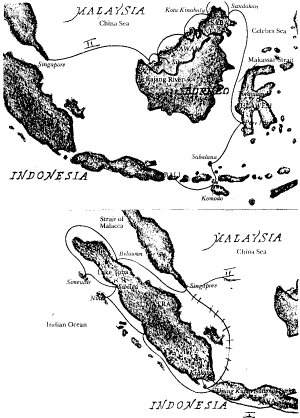
Indonesia-Singapore-Borneo-Bali-Java-Sumatra-Sarawak-Sabah-Sulawesi-Komodo
1991
Dear Char-Wel-Dor-Sue:
 Pat
and I have been to Indonesia on two previous occasions, and the
question may well be asked, why a third visit? And particularly at a
time when our country is virtually on the brink of a shooting war in
the Mid East. In answering, I can only say that my presence at home
would not alter circumstances in the Mid East, and I can pray (if I
choose to do so) as well here in Indonesia as at home.
Pat
and I have been to Indonesia on two previous occasions, and the
question may well be asked, why a third visit? And particularly at a
time when our country is virtually on the brink of a shooting war in
the Mid East. In answering, I can only say that my presence at home
would not alter circumstances in the Mid East, and I can pray (if I
choose to do so) as well here in Indonesia as at home.
Indonesia,
in the words of Bill Dalton, in his "Handbook of Indonesia" has this
to say of the country: "A country of incredible and diverse beauty,
Indonesia stretches over one-seventh of the globe between Malaysia
and Australia. This sprawling island chain encompasses
mind-stupefying extremes: five thousand meter high snow-capped
mountains of Irian Jaya, sweltering lowland swamps of eastern
Sumatra, open eucalyptus savannas of Timor, lush rain forests of West
Java, with lava-spewing volcanoes the whole length. After existing as
a Dutch colony for over 300 years, Indonesia fought for and won its
independence in 1949. The Archipelago, astride both the Indian and
Pacific Oceans, has been the seed bed of unique Asian and Australian
tropical marine, animal and plant forms. The most complex single
nation on Earth, each of Indonesia's six thousand-plus inhabited
islands has customs, native dress, architecture, dialects, ethnology,
and geography all of its own. Its Wayang Puppets, unearthly Gamelan
music, exquisite textiles, matchless and varied cuisines, hundreds of
tribes, ancient ruins and historical sites, wild life and nature
reserves and friendly people make Indonesia one of Asia's last travel
discoveries."
There
is yet another reason to revisit Indonesia and it is that I know, in
a superficial manner at least, the Judeo-Christian world, somewhat
less of the worlds of the Mid and Far East (Islam, Hinduism,
Buddhism, Taoism, Confucianism, Jainism), and far less of the Animism
and Shamanism of the more primitive cultures, particularly as in New
Guinea and Borneo.
As
one travels, one learns that there are no "absolutes" except perhaps
in the sciences such as mathematics and physics, etc., and that there
are certainly no "absolutes" in the world of religions, ethics and
cultures. Each of these areas is based upon its own heritage and,
unfortunately, has developed while unaware of the world outside of
it's own. Perhaps that is why we are in our present dilemma today in
the Mid East as we cannot resolve social problems with different
religious values and beliefs.
On
this trip, Pat and I were again reminded of the statement "If you
have time to spare, go by air". Our flight was delayed 17 hours in
Los Angeles due to a hydraulic leak in the nose landing gear. As a
consequence, we were transferred to the Airport Viscount Hotel and
given a voucher for dinner and breakfast. On this trip, we were also
reminded that Bali is a long way away; in fact, as I mentioned last
year, there is 21 hours of actual flying time, (LA-Honolulu five
hours, Honolulu-Biak eight hours, and Biak-Bali eight hours). To make
matters worse, since the airport at Bali is closed from 12 P.M. to 6
A.M. every day due to construction, we were obliged to fly to
Jakarta, lay over four hours, and then fly back to Bali, a flight of
two hours. Thus, we had accumulated a loss of vacation time of
approximately one day and our more extensive tour of Bali had to be
abbreviated. For us, having been to Bali previously, it was no great
loss, but to those who looked forward to the sights and sounds of
Bali, it must have been a major loss.
Our
visit to Bali was "deja vu". As you know, we had been there twice
before and really, nothing was new to us. The hotel was the same Nusa
Dua Beach Hotel at Sanur, and indeed one of the best of its kind in
Indonesia. Our city tour had to be shortened because of our late
arrival in Bali, but we did return to the capital of Denpassar, and
then on to several villages that are famous for their arts and
crafts. The first place was the stone-cutters village where beautiful
objects are carved from dark volcanic lava. Secondly, we moved on to
the silver and goldsmiths village where original works of jewelry
were created and finally to Mas, the wood-carving center of Bali.
Once again, we were impressed with the beauty of the wood carvers
art. Unfortunately, because the day was a holiday, the artisans were
away at the Temple, celebrating Metal Day, expressing their thanks
for all articles made of metal, i.e., their cars, refrigerators and
the like. This is yet another expression of the Balinese pantheonism
and animistic beliefs that everything in nature has a spirit or a
life force and should be recognized, and thanked with a ceremony at
the Temple. Offerings of food and flowers are laid at the foot of the
statuaries as an expression of gratitude. Every village, large and
small, has its temples and there are a great many festival occasions
and celebrations performed throughout the year.
After
leaving Bali, we sailed north on rough seas for a day along the west
coast of Java (Indian Ocean) to land at Cilicap, the port of entry
for Yogyakarta. This city, formerly the old capital of Java, was some
200 kilometers from our landing site and took four hours in a
speeding bus, escorted by two uniformed police officers on
motorcycles and a police cruiser with its red lights rotating and its
siren sounding. President Bush could not have been provided with a
speedier or better escort. Everyone and every form of vehicle was
pushed aside as we raced ahead, through one red light after another,
and even in the city itself. It was hair raising and frightening as
we dodged one vehicle after another. No one will ever forget this
experience, and the only casualty was a small goat hit by a second
small van in our party that was traveling immediately behind us. Our
visit to "Yogya" was primarily to see the magnificent Buddhist Temple
at Borobudur, the largest Buddhist shrine in the world, and
Prambanan, a magnificent complex of Hindu temples which is situated
not far away. When we were previously at Borobudur several years ago,
a fair proportion of the temple was covered with scaffolding and
reconstruction under the auspices of UNESCO was under way, Today, all
of that has been removed and one can see it in its full glory. There
is a lovely park surrounding the temple which is situated on a high
hill and pilgrims must descend a long series of steps to reach the
lower level or Terrace #1. Because we were with Society Expeditions,
we were driven in our bus to the very base of the temple and were
told only the President and very few other dignitaries were accorded
this privilege. Because of the tremendous weight of the temple, the
paneled walls of the lowest level had been pushed aside and the
soundness of the entire structure was in danger. As a consequence, it
was necessary to reinforce this level and in so doing, all of the
reliefs and carvings were photographed and covered up by the new
supporting structure. It was said that these panels depicted the
lowest levels of humanity, i.e., greed, vice, lust, etc., and that
perhaps this foreshadows the fate of man as he learns to depart from
his baser levels and ascends toward the God Life or toward Nirvana.
Beginning with the second level and walking upward on each successive
terrace, one can follow a pictorial history of the entire life of the
Buddha. This is one way the disciples of Buddha were able to teach
the illiterate masses the story of Buddha's life and his quest for
release from the pain and suffering of an earthly existence. The
final three terraces at the top are essentially devoid of human and
animal figures except for an occasional figure of the Buddha in a
sitting position. The forms that are seen are largely geometrical in
design.
On
the very top of the Stupa is a blunt conical spire representing
Nirvana, a state devoid of human consciousness and an escape not only
from this world but also from the process of reincarnation. There is
planted at the northeast corner a tree taken from the Bodhi tree at
the Buddhist "Temple of the Tooth" at Kandy, Sri Lanka (we visited
this years ago), and which in turn had been taken from the original
Bodhi tree at Varnasi or Benares, India. This was the tree where the
young prince finally obtained "enlightenment" (Jesus at Gethsemane)
and started out to teach his philosophy. He had left the security of
the palace and his wife and child to seek a way to relieve the
sufferings of his fellow man. His requests of the local priests for
help and guidance were fruitless and it was then through intense
meditation he discovered the Truth, namely that "greed" was at the
basis of man's problems, and by casting off all earthy possessions,
one could escape from the pain and suffering of this world. It is a
great story and depicted all over the world where Buddhism was
introduced. He never considered himself a God, as Jesus claimed to
be.
Borobudur
was built in the Eighth Century and took thousands of workmen
generations to construct. Unfortunately, it was abandoned as a wave
of Hinduism descended down the Archipelago from India. Gradually over
time, it was covered by volcanic debris and ash and was lost to
history until Sir Thomas Stafford Raffles, the Founder of Singapore,
discovered it during a period of British occupation of
Java.
The
other great religious shrine in Java is the Hindu complex of
Prambanan, built in the late Ninth Century. It is presently being
restored as much of it was broken down by a succession of
earthquakes. There are three main temples, each with a square base
and pyramidal in shape. The largest, (45 meters high) in the center
is dedicated to Shiva, the Destroyer, or God of Destruction, and it
is flanked on each side by temples dedicated to Brahma (God of
Creation) and Vishnu (God of Preservation). These represent the
Trinity of Hinduism. There are also many other temples devoted to the
pantheon of gods in the Hindu theology. There are three principal
colors among the Hindu pantheon and Brahma may be represented as
white, and the other two colors are red and black.
Just
beyond the park like setting at Borobudur and at Prambanan there are
stands where religious reliquaries are sold as well as all sorts of
souvenirs of interest to tourists.
Our
night in "Yogya" was spent in the Ambarrukmo Palace Hotel, the same
place we stayed at years ago, and once again, we were greeted in the
lobby by a Gamelan orchestra, all seated on the floor. Each had his
special instrument and all surrounded a singer in the center whose
singing was painful to my ears. Her voice was high-pitched and
sounded more like a screech than anything else, I suppose our
classical music must sound very strange to them.
After
dinner, we were entertained by Javanese dancers and the essence of
the art is slow movements of all extremities, especially of the hands
and fingers. Hyperextension of the fingers was carried out beyond
anything that an orthopedist would consider possible without breaking
a carpal bone or tearing a tendon. During our stay in the city, we
also visited both a traditional batik factory and also a batik
painting factory where framed works of art were available for
sale.
Batik
is the major industry in "Yogya" and is the world's finest,
acknowledged by all. It is sometimes called negative painting, wax
printing or wax resistant printing and can be done on cotton, linen
or silk. Finely detailed designs are first drawn with a pencil on the
textile, then hot wax impervious to the dye is applied with a pen
like instrument called a canting and equipped with a spout which
holds the melted wax. The cloth is dyed after the wax has hardened.
After dyeing, the wax is removed and the clear areas can then be
dyed. This process can be repeated many times. The art was considered
at one time a spiritual discipline and was only performed by ladies
of the nobility.
A
brief stop was made at a three dimensional puppet factory. These
puppets are manipulated by rods rather than strings. Shadow plays use
two dimensional puppets and are seen through a screen.
Christmas
Island, (Australia Territory), is situated 360 kilometers southwest
of Java, far out in the Indian Ocean. It is best known for its
phosphate mining which closed down in 1987 by order of the
government, and inspired by the threat of extinction of the Abbott's
Booby, a large endemic pelagic bird. In order to mine the phosphate,
the overburdened (tropical forest) had to be cut down and this not
only destroyed the forest but tore up the landscape, creating a moon
like landscape. Big business was shut down by conservationists and
environmentalists! Today, two-thirds of the island is a national park
and immune to any further destruction. We made two tours of the
island to see the Abbott's Booby, the Red Tailed and White Tailed
Tropical Birds, and the Golden Bosun. We also saw the Christmas
Island Frigate Birds which are similar to those that we saw in the
Galapagos and Antarctica. I, for one, was happy to visit Christmas
Island if only to get away from the rough sea and a feeling of mal de
mer.
The
single most distinguishing feature of Society Expeditions is their
faculty on board ship who lectured to us in a small modern theater
well equipped for slide, movie and video productions. On this trip,
perhaps the main attraction and star performer was Lawrence Blair,
co-author with his brother Lorin, of the book "Ring of Fire" and of
the four part video production of the same title. The latter was
shown at home on Public Educational Television. In addition, there
were two renowned ornithologists, a marine biologist, and an Asian
historian from Brown University. Each are outstanding in their own
fields of endeavor and do a fine job presenting their material and in
answering questions.
Every
evening before dinner, as mentioned previously in my Dad-O-Grams,
there is a 45 minute "Recap" where each lecturer reviews the
highlights and unique findings of the day. One cannot be everywhere
and with all of the field guides at the same time so it is a splendid
opportunity to see what was collectively observed by the
group.
On
all of the previous trips, I was accompanied by a pair of cameras and
rolls and rolls of film; this trip is different, as my constant
companion is a Sony Video-Eight Camcorder. It is so complicated that
I need a tutor to enable me to operate it effectively and to its
maximum capability. However, I do know, most of the time, how to
start and stop it, and hopefully I shall have something to show at
home. This will require considerable editing if it is going to be
really worth seeing.
Our
second "Expedition" was to Ujung Kulon Reserve on the north tip of
Java. It is a national park set aside in an effort to save the
rapidly dwindling population of the Java Rhinoceros, of which there
are only 45 still alive. The other sites in the world for the rhino
are East Africa (white and black rhino), Sumatra and India. We had a
Zodiac river trip that was completely unproductive as we saw no
birds, no flowers, no fish, only vegetative chlorophyll. Krakatoa
lies mid way between the north end of Java and the south end of
Sumatra and today, Krakatoa is represented by the remains of the
island of Rakata Besar. It consists of a small central volcano called
"Anak Krakatoa", (Child of Krakatoa) and some surrounding islands
which were probably the peripheral areas of the base of the island
which erupted. We went ashore on our Zodiacs and I had every hope of
making the summit (450 feet high) and to look down into the smoking
crater. However, it was all I could do to make the top of the mini
summit. Bill Dalton in his "Handbook Of Indonesia" describes Krakatoa
as follows: "Over a century ago, in August of 1983, the island of
Rakata Besar disintegrated in the most violent explosion in recorded
history when the central mountain erupted, an enormous amount of rock
was heaved out and the island collapsed, allowing sea water to rush
in to the fiery crater. The resulting explosion was catastrophic.
Countless tons of rocks, dust and pumice were hurled 27 kilometers
into the sky. Volcanic debris landed on Madagascar on the other side
of the Indian Ocean. The boom was heard in Brisbane, over four
thousand kilometers away. Atmospheric waves circled the globe seven
times. Tidal waves reached 30 meters high, wiping out 163 villages
along the coast of western Java and southern Sumatra and rocking
vessels as far away as the English Channel. After the initial
eruption, all remained calm in the middle of the demolished crater
until 1927, when a thick plume of steam roared from the sea bed and
before long, rocks and ash rose far enough to form a small cone which
is the one that we climbed while we were there. The Mentawais chain
of islands lie 150 kilometers off the west coast of central Sumatra
and we visited Siberut, the largest of the islands. Their belief in
magic is still prevalent and they still practice ritual taboos. Their
brand of Animism is again based on the belief that everything,
everywhere, is alive and possesses a soul, including states of nature
such as floods and rainbows, phases of the moon, trees and animals.
No object is ever thrown away while it is still functioning for it's
soul would be offended. Souls and the bodies they inhabit are
interdependent so what happens to the soul or spirit influences the
body and vice versa. Too much "soul stress" is the primary reason for
illness and death, as well as all other forms of adversity. They also
believe that every human enterprise interferes with the environment.
Misfortune occurs when harmony between themselves and the
environment, or nature, is disturbed. This is not a bad philosophy!
They search for the fault within themselves. Harmony is restored by
deliberately changing their behavior, abstaining from certain
activities. Thus taboos proscribes altered behavior. It is a working
system evolved over long periods of time, and enables tribes to live
with changing living conditions such as floods, food and animal
shortages and so forth. They respect nature and live within its
boundaries and do not do anything to endanger or to destroy it. They
hunt ecologically. They are gentle people and even paralyze
(poison-tipped arrows) the fish they spear to lessen it's pain.
Animism has more to be said for it than many of our man made
religions; at least, they are deeply concerned with the protection
and maintenance of the land, fauna and flora of their
villages.
One
of the finest features of an expedition occurs when we meet people
who welcome us to their islands or villages, and who, then in return,
are welcomed on our ship to share dinner and entertainment with us.
On Christmas Island, a group of Australians connected with the
National Park Service, our local guides and bus drivers and their
families including children were taken from the shore on our Zodiacs
and given full run of the ship including the bridge.
On
Ujung Kulon, a dozen students from Oxford University in England were
welcomed aboard for dinner and for them, it was a welcome relief from
their research on reptiles in the area and from living in tents along
the coast as they had been doing for a month or more.
Arriving
in Siberut in the morning, we anchored in the mouth of an inlet or
wide river and rode our Zodiacs upstream for seven miles! It was a
"wet landing"; in fact, the tide was out and we had to walk a
considerable distance in the mud to reach the shore. The welcoming
ceremony was brief and we were escorted into the "Long House" or
Communal Hall. Several dances were performed and the music consisted
of a bamboo drum and a tablespoon struck upon a piece of metal and
was the worst I have ever heard by any tribe. We wandered about the
village and saw absolutely nothing in the way of art; no paintings,
no wood carvings or sculpted figures and no stone objects. I
understand the tribes living along the coast or on rivers have an
easy time in life as their sustenance is largely obtained from the
river and as a consequence, they do not need to appeal to gods or
spirits for assistance. Those residing in the highlands, however,
have to subsist on hunting and minimal agriculture, and are largely
nomadic. They are the ones who have the carvings representative of
the spirits to whom they can apply for help.
Our
afternoon in Siberut was spent snorkeling and Pat and I saw some
remarkable corals. The sun was not out so their full color was not
appreciated. I wore a life preserver or flotation and had no
difficulty staying afloat. With negative buoyancy, I previously had
to struggle to keep my head above the water. It is more fun
now!
The
visit to Bawomataluo in South Nias was spectacular, exciting, and
totally different from anything I had ever seen anywhere else in
Oceania. We landed at Teluk Dalam, a ferry port for vessels from the
mainland, and serving as a central bus depot for various villages in
the area. We sat in a truck with benches and rode uphill on a narrow
road for almost an hour to reach the fantastic "Fortress Village" of
Bawomataluo. It is situated high on a hill and reached by a series of
80 stone steps. Upon reaching the central courtyard, the view was
striking. The town is laid out in the form of the letter "T" with
housing on each side of the street and, at the central point where
the cross forms the stem of the "T", there is an enormous Chief's
House that tapers about 40 meters high. Each street was lined on each
side with homes attached to one another and two stories in height. In
front of each were rectangular blocks of stone and round stone tables
on which are carved representations of plants and animals. It was
very clean and the people smiled and were most friendly. We were,
however, besieged with souvenir sellers and could hardly escape their
pleas for a sale. A formal greeting occurred, followed by dancing
that was wonderful to watch and needed no explanation. The costumes
were colorful with head dresses of bird's plumes and skirts of grass.
The men wore masks to create a frightening or war like appearance and
each carried a spear and shield. The music was a combination of the
marimba and drums. This village represented a zenith of the stone
culture indigenous on the island of Nias. There are many other
similar though less accessible megalithic villages, and it is
possible to walk from one to another with a guide. One can use the
Chief's House as the equivalent of a B and B accommodation. I used my
video camera a great deal and possibly, I may have something to show
at home that will give a better idea of this most unusual megalithic
village.
In
order to get to Lake Toba, the largest and highest lake in southern
Asia, we had to anchor at Sibolga on the northwest coast of Sumatra.
Buses then transported us to Prapat on the lake where we were taken
by a colorful chugging ferry to the island of Samosir. The bus trip
was long (six and a half hours) over a very serpentine road with
innumerable curves, U-turns, switch-backs, etc., and several suffered
from motion sickness. Personally, in all of my travels everywhere, I
have never experienced anything like it. Pat had no lunch at our stop
at Gur Gur and resorted to aspirin for her headache. I concluded that
Lake Toba must indeed be heaven for else, why would man build a road
to it? It was a single lane road but the trucks, buses, vans,
bicycles, motorcycles, made it a stressful experience. Our driver,
however, manipulated our Mercedes Benz bus with the skill of a race
driver and I have great respect for anyone who has driven to Lake
Toba from the coastline. I am quite sure he could drive anywhere in
the world.
The
Batak people around Lake Toba are most unlike all other Indonesian
people. They are vigorous, vibrant, exuberant, and they say a church
service on a Sunday morning would outdo any Black Baptist Service
deep in Dixie. We heard an example of their enthusiastic musicality
in the evening at our hotel, but had I closed my eyes, I would have
sworn I was in Guadalajara, Mexico, listening to mariachi
music.
Our
day on Samosir Island was delightful as we traveled from village to
village in a small two tiered lake ferry boat. Our first stop was
Ambarita, where we saw some old typical Batak houses and saw the
stone table and chairs that were used 200 years ago by the Chief and
his Council as a meeting place, and a "Law Court" to decide the
punishment of those who had violated tribal law (theft, adultery,
etc.) or were captured in raids upon neighboring villages. Using my
video, I recorded an enactment of a form of punishment which
consisted of preliminary torture and final execution.
Sinanindo
was our second stop and there we witnessed a series of dances with
very slow action and with deliberate and detailed movements of the
heads and feet. The small orchestra sat on the balcony of a beautiful
Batak house. The presentation concluded with a puppet show using full
size or almost life size characters.
Our
last village was Tumok, where we visited the royal tombs of the
founders of the Batak dynasty on Samosir Island. It was there that I
acquired my "Magic Wand".
On
our last day at Lake Toba, we boarded a bus and drove to Brastagi, a
resort area high in the mountains, and there we enjoyed lunch at a
beautiful hotel and restaurant and with a golf course! En route, we
stopped at the last king's home (Long House), which today is a
museum. He was executed by the revolutionaries because he was
considered a "Quisling", or friend of the Dutch, from whom
independence was being sought at that time. Also en route, we passed
through Medan, the capital of North Sumatra. The roadway was again
almost impossible and consisted of a one lane job with two lanes of
speeding traffic and with a thousand or more near misses. Yet, nary
did we ever see a sign of an accident, either old or new. The traffic
within the capital was bad, with busses, trucks, motorcycles, petty
cabs, and bicycles all competing for position and progress, and our
driver actually got out twice to argue with the others for the right
of way.
Singapore
is the garden spot of Asia and is perfectly beautiful. Perhaps there
is nothing else in the world to compare with it. Certainly, the
shopping is comparable to that of Hong Kong but the immaculate
cleanliness of the city is such that one is prompted to say it has
been sanitized. The streets are clean, the architecture exciting and
unique, and the shopping a problem for there is everything from
everywhere. The problem is in the decision making process. Given my
choice, however, I would choose Hong Kong because it is so hectic and
disorganized. The Botanical Gardens were re visited and they are
indeed wonderful, and the display of orchids is simply fabulous.
Although China Town has been reduced in area, it retains some of the
vitality and exuberance that was present on our two previous visits.
Lee Kuan Kew, the President, is a brilliant graduate of Cambridge,
England, and a master of social and city planning. His political
philosophy is "Democratic Socialism". Compulsory saving is one of its
pillars, and everyone must save! At the age of 55 or 60, all of one's
savings plus three percent interest is returned to the individual
free of all taxes. Each individual contributes each month 27 percent
of his salary and his employer 16 percent, or a total savings that is
mandatory of 43 percent each month. Any income above the figure is
taxed at increasing increments from one to 33 percent. Primary
education is free but secondary schooling, high school, and
university are paid for, and can be paid for "on time". Education is
not compulsory but simply taken for granted. There is no unemployment
insurance and everyone must work. Even for those who have little or
nothing only "work welfare" is available. Medical care is excellent
but again, nothing is free. You either work and contribute to the
economy or starve! The population is 2.3 million, 75 percent of whom
are Chinese, 15 percent Malay, seven percent Indian, and the rest
everything else. It is a melting pot and racism is decried. All
religions are tolerated but a Quaker would be quarantined as everyone
must serve a period of military service in order for them to create a
core of reservists. There is a President, Prime Minister, Council
Advisors (Senate) and a House of Parliament. It all adds up to a very
successful Republic of Singapore. Can you imagine being fined 150
Singapore dollars for failing to flush the toilet!! An unparalleled
economy has been built on bare rock; no natural resources, no oil,
coal, iron, timber, etc. Their only resource is people and the
incentive to work and to create. There is a Wall Street which is
overtaking the financial capital in this area of Hong Kong and there
are innumerable small industries which manufacture "Offshore" for
many American corporations, as well as those from Japan and Europe.
Our local tour guide remarked, as we drove by many beautiful homes,
that he suffered from AIDS, but what he meant was he suffered from
"Acute Income Deficiency Syndrome".
En
route to Kuching, the capital of Sarawak, and our first stop in
eastern Malaysia, we were once again informed in the lecture room
about Wallacea, the general area in which Alfred Russell Wallace
lived for eight years and conducted his research on the flora and
fauna of this region. In my Dad-O-Gram last year, I mentioned this
line, which is a theoretical line, but which actually provided the
boundary between two major tectonic plates, one being the Mainland of
Southeast Asia and the other being the New Guinea and Australian
plate. On the north or west side, or the so-called Continental side,
are found animals that are peculiar to its region and include
elephants and tigers, whereas on the other side of the line, the
Oceanic side, are found animals that are distinctly different, like
the marsupials. The reason is that during the last glaciation period,
when the sea level was much lower than at present, all of the
islands, such as Bali, Java, Sumatra, Borneo and so forth, were all
connected to the Mainland and animals could travel down from the
Mainland to this area. On the other hand, the Oceanic group were
indeed real islands and separated from the other group by deep
Oceanic trenches. It would not have been possible for animals then to
have bridged this gap of ocean.
Malaysia
is an interesting nation and consists of Peninsula Malaysia, or the
land lying between Thailand and Singapore, and Eastern Malaysia,
which is composed of the provinces of Sarawak and Sabah, both on the
western coast of Borneo. The little republic or monarchy of Brunei
separates Sarawak and Sabah. Kuala Lampur is the capital of Peninsula
Malaysia and is a beautiful city that Pat and I have visited
previously. There is distinctive Moorish architecture all over the
city and some Tudor buildings that remain from the period of British
occupation. There were many high rise commercial buildings which had
been built by the Japanese with moneys loaned by the World Monetary
Fund. The economy of Peninsula Malaysia is based largely on palm oil,
tin and rubber, whereas that of Eastern Malaysia is based primarily
upon the export of timber and that of oil and natural gas.
Our
trip up the Rajang River to visit the rapidly growing town of Serikei
was fascinating, as much of the shoreline was covered with huge logs
or tree trunks of iron wood or, the equivalent of what we could call
Philippine mahogany, and all were waiting to be shipped all over the
world. Timber is the only export in this area and it is indeed big
business. One can understand what they mean by the "Rape of Borneo"
as the wholesale clearing of the tropical rain forest is occurring at
the present time. It takes some 80 to 100 years to replace these
magnificent trees. Borneo, however, is the third largest island in
the world so while there is an immediate concern, there is,
nonetheless, the realization that it cannot go on at this rate, or
else the biomass of this area would be severely depleted.
Entertainment
in the evening frequently will consist of a documentary educational
video film or a popular movie and on this cruise, we saw "Driving
Miss Daisy" and also "The Dead Poets Society".
Lectures
on board ship, as I have said, are the hallmark of Society
Expeditions, and at Singapore, we ]lost two fine ornithologists
and gained an English Environmental and Mammalian Ecologist who works
for the World Wild Life Fund of Malaysia. He presented in a
comprehensive fashion, in both words and slides, all one needs to
know about the ecology of this area, and the real need to preserve
our rain forests and endangered species. His job is to do original
research as there is so much in the natural sciences that is unknown
or undiscovered in Borneo. Who knows what incalculable resources are
waiting to be found to be added to our medical armamentariums such as
new antibiotics, tranquilizers, and medicinal drugs?
Our
visit to the Niah Caves was promised as a "Long Day" and started out
with a long Zodiac ride into the city of Miri (Sarawak), where we
boarded buses for a three hour trip to the Niah National Park. Here,
we were registered and visited the local museum and then crossed over
a small river using narrow unstable canoes with a small outboard
motor. Then we began a three kilometer walk on an elevated wooden
walkway to reach the entrance of the cave. It was in this cave that
evidence was found that homo sapiens may have been here as long ago
as 37 thousand to 40 thousand years ago, and cave paintings were
found with burial urns containing human remains. No bats were seen as
they were resting prior to starting out in the evening in search of
insects. A few cave swallows or swiflets were seen and we saw how the
local people, called Ebans, climbed tremendously high bamboo ladders
to dig out the swiflets bird nests so highly prized by the Chinese
for their bird nest soup. Vast quantities of guano are still being
harvested from these caves.
We
started down the river in our Zodiacs but since trouble had developed
with two of them, we had to double up and took some 18 to 20 people
instead of the maximum of 12. Our going was slow, the sun set and we
enjoyed a beautiful sunset with its afterglow. It gradually got
darker and darker and lightening appeared on the horizon. What
promised to be a two hour Zodiac ride turned out to be three and a
half hours and most of it, certainly the latter part, was in pitch
darkness. Soon, one after another of the Zodiacs developed problems.
Several ran aground on sandbars and had to be towed off and all
finally ran out of gas and had to be refueled in the dark.
Fortunately, we had several spotlights aboard and could see the river
bank and only the river bank! In short, we were driving blindly in
the river for some time until we saw the brilliantly illuminated ship
far off in the ocean. At this point, we ran into the ground swells
and the bow rose and dropped approximately eight feet and it was
rough going. We were all covered with sea spray. It was a harrying
experience but our Zodiac drivers (two) handled the boat well and we
never really felt threatened with a capsize. These Zodiacs are sturdy
seaworthy vessels and when we finally arrived back at the Mother
Ship, the Captain personally assisted us aboard. Free drinks were
served to all for it had been a most exciting experience.
The
Sultan of Brunei is the richest man in the world, or so it is
claimed, although I would think that the Royal Family of Saudi Arabia
and the former Monarchs of Kuwait would rank ahead of him. However,
his family is small and after what we had seen today, I am inclined
to go along with Forbes Magazine's rating of him as #1 in the world.
His magnificent palace, 500 polo ponies, a half dozen polo fields
with viewing stands, a super race track and three golf courses adds
up to a personal opulence beyond anything I have ever seen. No doubt
in times past, there were monarchs who may have surveyed empires that
were more opulent but in this present day, he appears to be the
wealthiest in the world. Here, there is no redistribution of the
wealth for it is an absolute
monarchy,
hierarchical autocracy, all based on its wealth of oil and gas. A
high standard of living prevails and the average per capita income is
$23,000. However, this is misleading as the Sultan's wealth is used
in calculating the average wealth of the 200,000 people who live
here. Brunei is the size of Luxembourg in Europe! Shell discovered
offshore oil here early in this century and today, 50% of it is owned
by the Shell Oil Company and 50% by the Brunei government. The
natural gas is distributed with one third owned by Shell, one third
by the government, and one third by Mitsubishi of Japan. The gas is
liquefied by cooling and then shipped to Japan, and we were told that
it is adequate to light the major cities of all of Japan! Most
everything that we saw or that moved in the way of cars, trucks,
tractors, hoists, were all made in Japan. I did not see a single
American car.
While
in the city, we visited the beautiful Gold Domed Mosque, the
magnificent Brunei Museum with its priceless Islamic calligraphy and
heirlooms and dioramas of Islam life, the Churchill Memorial and the
Sultan Hassan's Aquarium. Finally, we had a riverboat tour of the
"Water Village", a sort of Venice built on sturdy wooden pillars and
using outboard motored craft instead of gondolas. Twenty seven
thousand people, or half of the city, live here, like the boat people
in Aberdeen, Hong Kong. Everything they need is here including
mosques, schools, markets, entertainment, etc., and, like in Hong
Kong, the government is trying to get them to give up their
traditional life on the waterways and go into public housing on land.
At the end of the day, we were received by the Ambassador and Mrs.
Phillips at their residence in the country and enjoyed "Tea" with
soft drinks, beer and snack bits of food including crisp Chinese egg
rolls and all sorts of cookies, pastries and fruit tarts. He was a
gracious host and was really glad to see us for it must be lonely
there as it is well off the tourist route.
Of
personal interest to my cousin Muriel Hastings was the fact that the
very first person I met in the Lounge after leaving Singapore was Mr.
Frank Jungers, and his wife Julie. They live in Portland, Oregon, and
he recently retired as Chairman of the Board of Aramco, the largest
oil company in the Middle East. Formerly, Aramco was a consortium of
American Oil Company but is now fully owned by the Saudi Arabian
government. He remembered Mina Hastings, Muriel's daughter, who was
hired as his Industrial Psychologist.
Many
of the people on the second segment of our trip and who came on in
Singapore were members of the World Wild Life Fund and included among
these was it's President, Mr. Russell Train.
A
few remarks in general about Borneo may be of interest. Eighty
percent of the territory is jungle, though the lush native vegetation
doesn't mean fertile soil. The rain forest soil, minerals and life
energy never accumulate as humus, such as happens at home and in
temperate climates. Nutrients are perpetually "stored" in the diverse
plant life with the help of an extremely efficient recycling system;
bacteria, fungi, insects, and animals. A naturalist with jungle
experience recently traveled to the deep interior of Borneo for 28
days without coming into open sunlight or encountering any sign of
cultivation. The elusive and endangered orangutan, "Man of the
Woods", lives here (also in Sumatra) and is a mild tempered, playful
vegetarian tree dweller or an anthropoid arboreal ape with no tail.
Its young look very much like our baby infants and are adorable as
pets. Since the orangutan is now an endangered species, it is illegal
to possess one, and all must be declared and turned over to the Wild
Life Organization of Sabah. Then they are transferred to the
Rehabilitation Center and efforts are made over months of time to
reintroduce them into their natural habitat. The extensive logging
here has destroyed their natural home in the rain forest and many
were killed by falling trees or shot for their young offspring by
hunters. We saw them at the Rehabilitation Center at Sepiloc at one
of their feeding centers, and they amused us with their antics,
stealing anything available, including hats and camera lens
caps.
We
stopped briefly at Sandakan which was formerly the old capital of
Sabah and visited the large market. It was very crowded and we had an
opportunity to see the various varieties of fish that were caught in
these waters and the wide variety of tropical fruits which were now
just coming into season. There is a Chinese Buddhist Temple high on
the hill overlooking the city and it was unlike any other Buddhist
Temple that I had ever seen. The predominant colors were red and gold
and there was lavish ornamentation.
After
leaving Sabah, we cruised southbound for a day in the Sulu Sea and
arrived at Towali, a small village on the west side of South
Sulawesi. Our Zodiacs took us ashore to be welcomed by a reception
committee, a small Gamelan type of orchestra and several dance
groups. Various wooden objects and some woven silk fabrics were
available for sale, but none appealed to either Pat or me. Later that
morning, we had excellent snorkeling with a great variety of corals
and reef fishes, and then continued south to Pare Pare, the real
reason for taking this segment of our tour in Indonesia!
"Toraja
Land" was the principal reason Pat and I decided to sign on for the
second segment of our expedition. Of course we wanted to see Sumatra,
the fifth largest island in the world, and Borneo, the third largest
island, but Sulawesi was the island on which the Torajans lived, and
it was their typical houses and their funeral rites that intrigued
us, and which we wanted to see first hand. We were not disappointed,
and their houses that resembled ships sailing in the forest were
every bit as exciting as foretold. The roofs have a saddle appearance
with the front and rear ends rising high in the sky, and both the
front and rear aspects are covered with geometric designs in red,
white and black colors. The structure is of tongue and groove
construction and is supported with square wood columns, and can
actually be lifted up and moved if desired, although it would take an
army of men to do so. They always point north or toward their point
of origin (Indochina). Behind each dwelling is their rice or grain
house that resembles a miniature house, and is smaller and mounted on
round pillars to prevent rats from getting at the stored grain or
rice.
The
Torajans were once fierce headhunters and completely Animistic in
their culture. Today, they are largely Christianized and instead of
offering "heads" to their Gods, they offer water buffalo and pigs.
Their funeral rites or "Feasts of the Dead" are most unusual and the
celebration of death is a happy occasion!! We were most fortunate to
attend such a ceremony and it is impossible for one raised in our
culture, with our beliefs and value systems, to completely understand
these rites. A person may die today but his body will be wrapped and
wrapped in shrouds and may lie in his house for a year or more, and
the spouse will never leave the body until the family has raised
sufficient funds to provide a proper burial befitting his or her rank
in society or caste. Then and only then can the ceremony be held, and
all the family members from far and near and all of their fellow
village friends gather together for the event. Each family and friend
contributes according to their ability and, later in return, the
deceased's clan members contribute the same with interest! It serves
to redistribute the wealth and all take home part of the sacrificed
animals and accumulation of foods contributed to the event. Unless
these traditions are followed, the deceased's soul wanders aimlessly
and does not leave the local area and can cause harm and misfortune.
It may take a day or three days or five days or even a week or ten
days to carry out the festivities. A single water buffalo and several
pigs may be sacrificed, or else, in the case of those with more
prominence in the community, as many as a hundred buffalo and
hundreds of pigs may be sacrificed. All of this assures, so they
believe, a happy dwelling place for the deceased's soul. The body is
then placed in a wooden coffin and buried in niches in the sides of
nearby mountains or in natural eaves throughout the mountain. The
more prominent the personage, the higher the niches are dug in the
side of the mountain and rendered more inaccessible. We saw such
sites and saw deteriorating coffins and piles of bones and skulls.
Also in front of the buried niche are wooden stereotype figures
called "Tau Taus" that represent the spirits of the dead people. It
is the strangest sight that I have ever beheld and represents, in a
cemetery at least, an extreme example of the veneration of one's
ancestors. "Toraja Land" is an unusual place and people travel from
all over the world to see it!! To get there was arduous, with four
and one half hours of frantic driving on narrow roads high up in the
remote highlands or mountains. These people are Christian by virtue
of their extreme isolation and the fact that it is only missionaries
that have sufficient zeal to climb this high to effect their
conversions. The Arabs, on the other hand, were coastal traders and
they confined their evangelism to the shore communities, the trading
routes, and to those small villages that were on river approaches and
more easily accessible. Although the Indonesian Constitution states
that there is only one god, the government tolerates all religions.
It is evident, nonetheless, that all of the formal religions have a
considerable admixture of underlying Animism.
After
leaving Pare Pare, we cruised southwestward to the Sabalana islands,
a beautiful chain of atolls with tall palm trees and brilliant white
sandy beaches bordered with crystal clear waters and coral reefs. Our
choice was Balobaloang Island. The sea was choppy and I elected to
Zodiac ashore and to walk through the Moslem village and see the
town. It was immaculately clean, as it is swept or broomed every day.
No litter of any kind, only fallen coconuts and palm fronds. All the
men were out fishing and the women were in thatched huts along the
shore, engaged in removing seaweed or agar agar from strings that had
been set up as sea gardens (lattice-like) just off shore. Agar is in
short supply and brings a good price. Every bacteriologist knows
about agar plates used as culture media, and women are familiar with
its use as a vegetable thickening. We also saw a fairly large and
traditional Bugie Boat being built, all by hand and using the crudest
of tools. No nails of any kind, only dowels to hold the planks
together. Some form of greenery is used to caulk the open spaces
between the planks and apparently, these distend when wet to render
the structure water tight. If my snorkel were three feet long, I
might have ventured into the rough sea.
Our
last day at sea prior to disembarking at Bali was spent on the island
of Komodo, noted for its "Dragons" or large monitor lizards. A
description of these was included in last year's Dad-O-Gram. This
year, I was full of excitement as I was equipped with a video camera
and, alas, the show this year was an anticlimax! All the dragons were
assembled in the pit, or dried up river bed, and awaiting, as we
were, the lowering of the freshly killed goat. Last year, there was a
frenzy of feasting as they climbed one over the other to reach up and
tear the goat apart. This year, they dismembered the goat and placed
it just outside our enclosure high above the pit and only four
dragons were interested. A tense moment, however, developed when a
dragon broke through the gate, bit one of the rangers, and scattered
the tourists far and wide, some falling over one another to get free
of the beast. I was too far away, positioned for a beautiful shot in
the pit (which never materialized) and I missed all of the
excitement. Incidentally, I bought a replica of the dragon carved in
mahogany from our escorting ranger. The village of Komodo was
formerly a penal colony of the Sultan and the place looked like it,
with no concern for its appearance and litter everywhere. Even the
Mosque was hardly standing upright!
Our
last afternoon was spent in snorkeling at a small cove and pink sand
beach on Komodo Island and it was magnificent, especially when the
sun emerged from some cloud cover. Then the full cover of the soft
corals waving in the current was, for a landlubber, sheer pleasure.
Last year, it was the same, with corals of every color of the
rainbow, and reef fish of all sizes, configurations and color
combinations! No place that I have ever snorkeled matches this for
showing marine life so vividly and so beautifully. It is a fitting
climax to our expedition and there only remains the Captain's
Farewell Dinner this evening and a day and a half in Bali preparing
for our return home.
Love,
Dad
CEJ/ngb
or