La Belle France
October 1992
Dear Cha-Wel-Dor-Sue,
 Our
desire-to spend a month in France was prompted by an invitation from
Les Amis DeVin (Friends Of Wine) to join a group in Bordeaux and
visit many of the world's renown chateaus in this area. After having
determined to make this trip (twelve days), Pat and I decided to use
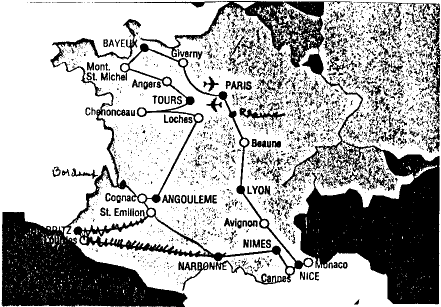
this opportunity and make a back to back Grand Tour of France,
visiting most of the major cities and historical sites in the
country. By so doing, we would have five days in Paris and an
opportunity to visit many areas that time did not permit us to visit
on our only other previous trip to France with the
Pilpels.
Our
desire-to spend a month in France was prompted by an invitation from
Les Amis DeVin (Friends Of Wine) to join a group in Bordeaux and
visit many of the world's renown chateaus in this area. After having
determined to make this trip (twelve days), Pat and I decided to use
this opportunity and make a back to back Grand Tour of France,
visiting most of the major cities and historical sites in the
country. By so doing, we would have five days in Paris and an
opportunity to visit many areas that time did not permit us to visit
on our only other previous trip to France with the
Pilpels.
Delta
Airlines was our transatlantic carrier and we used our free round
trip coach tickets obtained through their Frequent Flyer Program. It
was no surprise that we left from Hartford, but it was when we
learned that our plane for Paris departed from Cincinnati, Ohio! Our
flight was uneventful and we landed at Orly Airport some eight hours
later. Our tour representative from Globus Tours met us at the
airport and we were driven by bus to the Hotel Mercure on the virtual
outskirts of Paris. The accommodations were adequate and to our
relief, a Metro or subway station (Pte. des Versailles) was
immediately in front of the hotel. We used the "Tube" every day we
were there and bought packets of tickets of ten for 35 francs each,
or approximately $7. A single trip would have cost us five francs, or
a dollar.
France
is a diverse country and often compared to an hexagon, with its
borders being the English Channel, Atlantic Ocean, Pyrenees
Mountains, Mediterranean Sea, Alps Mountains, and the Rhine River. It
is both a Northern and Southern European country, connecting the cold
Atlantic Ocean with the warm Mediterranean Sea, and the lofty
Pyrenees Mountains with the flat lands of Flanders. Each of its
regions is quite different from the others and its diversity adds up
to its interest and charm. At 212,000 square miles, it is the largest
European country after Russia and 37th largest in the world. It
stretches 590 miles from North to South and East to West and covers
one time zone one hour East of Greenwich time. The time zone is six
hours ahead of our Eastern Standard time or New York time. France has
some 1800 miles of Atlantic coastline and numerous ports and, of
course, fishing is an important part of their economy. It is the
fifth largest economic power in the world and it proved to be, to my
surprise, primarily an agricultural nation!
The
government is a republic with a president who is elected for seven
years and who appoints the Prime Minister, who heads the government
and its ministries. The National Assembly (Departments) and the
Senate (Regions) constitute the two powers of Parliament. The country
is Divided into 22 Regions and 96 Departments and in 1990, had a
population of 56.3 million people, 73% of whom live in towns. There
is a multitude of political parties and rule by coalition is almost
invariably necessary. The French are fiercely independent people and
feel that they have the inalienable right to form their own political
parties. In this regard, I will never forget my first impressions
with French culture when I visited Fort de France in Martinique as a
ship surgeon on the Grace lines in 1938. The place was filthy and I
came away convinced that the French fought for the right to defecate
in the streets and exercised that right! The streets were open
sewers!
Paris
is known as a walking city and deservedly so, and I truly believe Pat
and I walked at least five miles every day. As a result, we were
exhausted at the end of the day and had little energy left for seeing
the town at night. The metro or subway system is very efficient and
covers all of Paris, but it usually takes one only to the vicinity of
one's destination and one must walk the remainder of the distance,
the only exception being the Louvre Museum, which has its own metro
station. To see the various monuments, towers, parks, and museums of
Paris, one must resign himself to a lot of hiking unless, of course,
one can secure a chauffeured car or hail taxis, both expensive
propositions.
The
highlights of Paris, from an artist's perspective, were our visits to
the celebrated Louvre Museum, where art from time immemorial to the
year 1844 is displayed, to the fascinating Museo de Orsay, where art
from the year 1844 to 1914 was displayed, and to the Pompidou Center,
where modern art from the year 1914 to the present time is exhibited.
The architecture of each of these three museums is distinctive and
all were well designed to display their respective art treasures. The
Eiffel Tower, rising 1051 feet above its base, afforded us a
beautiful view of the city. We did not go to the top for to do so
would have required hours of waiting in line. Visiting the Invalides
enabled us to retrace France's military history by wandering through
its remarkable military museum. Napoleon's red porphyry mausoleum in
the Dome Church was breathtaking. Rodin's Museum was just a step
Taway from the Invalides and contained virtually all of Rodin's
works. It was very obvious that he was a prolific sculptor and to my
surprise, I found myself somewhat disappointed with his works. They
appeared to be hastily constructed and rather crude compared to the
ancient sculptures seen in the Louvre. A stroll along the Champs
Ellysee led us to the Arc deTriomphe but the views along this
boulevard were marred by construction for an addition to the subway
system. Unfortunately, time did not permit us to climb to the top of
the Arc deTriomphe for it would have afforded a beautiful view of the
most celebrated boulevard on earth. A long walk through the Tuileries
Gardens was delightful, after which, we strolled along the Rue
deFaubourg and the St. Honore, the Parisean equivalent of New York's
Fifth Avenue. There were no bargains, and to make matters worse, the
dollar had just reached a new low compared to the French franc. A
visit to the Sacre Coeur Church, high on Montmartre's hill afforded a
lovely view of the city, and there were the usual clusters of
artists, creating, displaying, and selling their art works.
Unfortunately, we never took advantage of the opportunity to visit
any of the finest restaurants in Paris, and most of our time was
spent eating in little bistros or Brasseries, where good food was
readily available.
Our
first stop on our Grand Tour of France was to Versailles, and I was
impressed by how much this beautiful city had grown in size since our
last visit. It was immaculately clean, beautifully landscaped, and
trees and flowers abounded everywhere. It was here that you will
recall the King, Louis XIV, and his court would amuse themselves away
from the stench and conspiracies of Paris. It was here that the King
transformed the small village and small hunting lodge and chateau
into an unequaled display of wealth and privilege. While we enjoyed
our tour of the Palace, it was less complete than the one we took
with Walter and Yvonne Pilpel many years ago. On this occasion, the
King's apartment in the center of the symmetrical palace was not
included in the tour and would have required a second ticket and
another wait in line in order to do this. On a bus trip, this was not
possible. Despite this omission, it is still one of the most
magnificent palaces created by man, and the droves of people from all
over the world testified to this fact.
Chartres
was our next visit and I will long remember the view from the
distance of the towering spires. The present cathedral, the fifth at
least on the same spot, was constructed in less than 30 years, after
a fire in 1194 had destroyed most of the city and its Romanesque
cathedral. Chartres has been a pilgrimage shrine for centuries as it
has been recorded that Charlemagne's grandson, Charles The Bold, gave
to Chartres the Sancta Camisea, accepted as having been worn by Mary
when she gave birth to Christ! Mary's relic is now in the cathedral's
treasury. Rodin referred to Chartres magnificent cathedral as the
"Acropolis of France". It is renown not only for its size (fourth
largest in the world) and for its development of the flying
buttresses and lateral support of the walls, but also for its
unsurpassed stained glass windows. Fortunately, it was not seriously
damaged in the recent wars.
Rouen
is the capital of Lower Normandy and famous for its spacious
cathedral which, during our visit, was being treated to remove the
dirt and grime of centuries. Many of the old town's narrow streets
are pedestrianized and lined with street vendors or shops displaying
their ware at the curb. It looked initially like a tow-wide flea
market. At the end of the Rue de Republique is a modern complex and
shrine dedicated to Joan of Arc. It marks the spot where Joan of Arc,
aged only 19, was burned at the stake following her trial as a
heretic (1431). Twenty-five years later, she was rehabilitated and
today, a very modern church with beautiful wooden accouterments and
magnificent and story telling stained glass windows occupies the site
in her memory.
Normandy
was our next area visit and en route to Bayeaux, we toured through
Caen, known as "Caen The Crucible". It was here that shells landed on
D-Day itself and the city burned for 11 days. After it was liberated
by the Canadians on July 9th, it was still bombarded by the Germans
for another month. Thus, it is obvious why today, it is a completely
rebuilt city and nothing of the past is preserved.
Bayeaux
is the site of the Bayeaux Tapestry, an extraordinary masterpiece of
embroidery, probably made in England soon after the Conquest. Its 58
episodes with headings recount the story of the Norman Invasion. It
is an unparalleled work of art and a historical document of the first
order. It is not a tapestry in the usual meaning of the word but a
series of appliques stretched upon a coarse linen background. It
measures 280 feet long and 33 inches wide and contains an abundance
of pictures including men, ships, horses, buildings, and an almost
infinite number of details about life in the Eleventh Century. One
could no even superficially comprehend the mass of information that
passes before one's eyes as one slowly moves by the long, illuminated
glass-enclosed work of art.
It
was on D-Day, June 6, 1944, and at Normandy beaches, that the
invasion of Europe in World War II began and the door blocking
Europe's freedom was first breached. On a coast where all sorts of
fortifications had been constructed, including concrete pill boxes
and bunk-houses, artillery batteries, mined beaches with spikes,
piles, barbed-wire entanglements, and dunes and roadblocks, the
invasion began. To visit some of these sites, as Pat and I did, makes
one wonder how we ever got a foothold in France and won the war. At
Hoch Point, our boys had to climb cliffs on the top of which were
heavily armed German soldiers under Rommel's command in their
hardened concrete bunkers. The Second-Rangers Battalion succeeded in
climbing these cliffs using fire brigade ladders installed on rafts.
They scaled the summit after shooting grappling irons and ropes into
the cliff face under close-naval artillery cover, a Homeric epic! A
visit to the American Cemetery at St. Laurent, or Omaha Beach, is a
moving and solemn experience. It occupies a piece of land deeded to
the USA and contains the remains of almost 10,000 of our 20-year-old
heroes. It reminds us that Peace and Freedom are not cheap and not
infrequently, in the course of human history, that war seems to be
justified to provide a better world for its and succeeding
generations. At Arramanches, we enjoyed lunch and saw the remnants of
the floating piers that had been used for the delivery of equipment
during World War II and which had been destroyed later during a major
sea storm.
Mont
Saint Michel is one of the greatest religious buildings in Europe and
represents 500 years of work from the Eleventh to the Sixteenth
Centuries. The first Abbey on this site was built after the Archangel
Michael appeared to Aubert, Bishop of Avranches, in the Eighth
Century. It is constructed on the top of a huge mound of granite and
towers 500 feet above the sea and the surrounding flat area. The site
is unique in that occasionally at high tide, it is surrounded by
water. A quaint and charming city exists at its base with all sorts
of restaurants and souvenir shops and it is one of the major tourist
attractions of France. The Abbey buildings and the Cloister adorn the
summit. It is a long climb but worth the effort for the beautiful
vistas of the coastline. When seen from a distance, Mont Saint Michel
makes a profound impression which one does not soon forget. It is a
gift of the land and the sea and a work of the hand of man! As a
fortified site, it was never conquered and religious pilgrims still
flock to it today.
The
chateaux of the Loire Valley are well known and extensively
photographed for their beauty. Attention has been directed at this
area because it is considered to have been the heart of the French
Renaissance Movement, and its buildings represent architectural
artistry at its very best. When the house of Valois returned from the
Wars in Italy, they brought back with them ideas of Italian court
life, a life of culture, elegance, ostentation, and one immersed in
luxury and a love of the spectacular and of being seen! It seems that
the measure of French influence at that time changed from that of
being a military power to one of living a life of culture and
sophistication and Charles VIII, Louis XII, and Francis I, carried
this out magnificently. The pomp and ceremony of the Italian Visconti
Court transformed the staid fortresses of the French nobility in the
Loire Valles into flamboyant chateaux with ornamental motifs,
friezes, chimneys, magnificent gardens, fountains, hedges with flower
beds, ornamental waterworks and all of the like. As the ultimate
importation of Italian art and science, Francis I convinced Leonardo
da Vinci to return to France with him and converted a residence,
Clos-Luce, into a home for him to occupy in his final four years of
life. He is buried in the chapel at this site and a splendid museum
devoted to the genius of Leonardo exists in the basement of
Clos-Luce. This museum was funded by the IBM Company and contains
illustrations of Leonardo's original designs and models and displays
very vividly the creativeness of this consummate genius of the Arts
and Sciences. While in the Loire Valley, we visited the palaces at
Amboise, Chenonceau, and Chambourd, but a description of each would
entail a story unto themselves and there is yet more to tell of my
Grand Tour of France.
Bordeaux
was our next stop but my comments about this remarkable city will be
told later as I relate my experiences in Wine Country.
Avignon
is renown for being the site of the Palace of the Popes and was to
have been our next stop on our Grand Tour but unfortunately, the
truckers' strike changed all of that and the city of Avignon was
completely blocked and inaccessible. Ultimately, we found our way to
Nice, crossing the Black Mountains at the southern end of the Grand
Massif and all along the way, seeing traffic and trucks everywhere.
The gendarmes were helpless and this congestion lasted approximately
a week until the military forces forcibly removed the trucks from the
roads. In the meantime, it altered our itinerary and we spent more
time on the road than would normally have been required. It did have
one virtue in that it took us off the main autoways or the equivalent
of our interstate highways and necessitated our using the state or
local roads. In so doing, it enabled us to see the small towns and
the out of way sites which we would never have seen and
enjoyed.
Nice,
Cannes, Monaco, and Monte Carlo had been visited on a previous
occasion and described in one of my previous Dad-O-Grams. Grasse, a
suburb of Nice, was visited on this occasion and an interesting visit
was made to a perfume factory. We learned there that there are three
methods of obtaining the essence of flowers; enfleurage or pressing
the flowers, extraction with solvents, and thirdly, distillation. It
goes without saying that virtually all of the perfumes made in France
originate in Grasse.
The
Route des Grandes Alps was taken from Nice to Lyon, and was most
picturesque. It took us through Grenoble, the site of a previous
Winter Olympics, and enabled us to historically retrace the steps of
Napoleon after he escaped from Elba in 1815 and returned to Paris in
triumph. His remark that "The eagle will fly from steeple to steeple
until he reaches the towers of Notre Dame" is part of French
history.
Our
visits to Lyon and Dijon were so abbreviated by the long periods of
time taken to get there on the country roads that we saw very little
of the cities themselves. However, while in Dijon, we did see the
Annual Parade of the Brotherhood of the Societie of Confrerie
Gastronique, all garbed in their colorful ceremonial
robes.
Driving
north from Dijon to the town of Beaune, we drove through the
celebrated Wine Districts of the Beaujolais, Maconnais, and the Cotes
but unfortunately had no time for a visit or a tasting. The town of
Beaune was a delight and one of the most beautiful and well-preserved
of the small towns we visited in France. It would deserve a revisit!
It is most unfortunate when one comes upon a Beaune and must see it
and leave it in 30 minutes. It is truly an open air museum of a town,
the heart of Burgundy, and where the old powerful dukes of the Dutchy
of Burgundy ruled for many years. Its Hospice or Hospital for the
Poor is distinguished by its colorful, geometrically designed and
patterned tile roofs and ornamental spires.
En
route to Rheims, we stopped at Eperney and visited the famed Moet and
Chandon Champagne Establishment, home of the super luxury Dom
Perignon Champagne. Dom Perignon was the cellar-master at the Abbey
of Hautvellers at the end of the 17th Century and he is credited with
being the creator of champagne as we know it today, a wine of
inexhaustible bubbles and of unique sparkle and liveliness. This
process involves a double fermentation, the first occurring in casks
and the second in the bottle. The bottles are tilted on racks with
the necks down and turned frequently and when all the sediment has
accumulated in the neck, this portion of the bottle is frozen. When
the cork is removed, the frozen plug is blown out. At this point,
wine with varying amounts of sugar is added to create the various
strains of the champagne: Brut (dryest), Extra-Dry (less dry), and
Sec (least dry). The DemiSec and the Doux are quite sweet and can be
considered dessert wines. Most champagnes are aged in the cellar for
three years or more. Beneath the city of Eperney, there are stored
over 29 million bottles of champagne in 19 miles of tunnels where
there is a constant humid cool temperature that is ideal for storing
wines.
Cognac
was one of our stops en route to Bordeaux and we visited the ancient
and historic Otard S.A. Chateau. A well-presented audiovisual show
started us on our underground tour and we naturally ended up at the
bar, tasting their fine Cognac or brandy. Cognac, like Armagnac, is a
product of two distillations of a locally produced thin acid wine of
low alcoholic degree. It was interesting that the process of making
Brandy evolved because wine shipped to England frequently arrived
sea-sick and deteriorated rapidly, and since the essential taste
could be preserved and the alcoholic content increased by
distillation, this technology was created for the English market and
has endured until the present time.
"People Who Know Choose Bordeaux"
Bordeaux
is France's fourth largest city (population 210,000) and sixth
largest port and lies 61 miles from the Atlantic Ocean on the Garonne
River. Today, except for abandoned wine warehouses along the quays in
the Chartron District, it has the elegant appearance of long-standing
prosperity. This success in the past was based upon the export of
wine by sea to Great Britain and the Netherlands, a trade that
continued throughout the Hundred Years War with England! In this
context, it is well to remember that Bordeaux was the capital of the
Acquitaine, a province that belonged to England for three centuries.
Today, trucks transport the wine to Bordeaux Atlantic seaports for
worldwide distribution and the river traffic for transportation of
wine is almost nil.
The
highlights of interest within the city of Bordeaux include: 1) The
Grande Theater or Opera House, with its classic Louis XVI style of
architecture and a colonnade running entirely around the building and
its great staircase resembling that of the Paris Opera House. 2)
Parliament Square. 3) The Esplanade des Quinconces and its Monument
to the Girondes, a plaza bordered by a beautiful and orderly planting
of trees and featured at one end with a column 164 feet high topped
by Liberty throwing off her chains and with two huge bronze fountains
at the base symbolizing the triumph of the revolution. 4) The Maisson
du Von of Bordeaux, an ultramodern structure housing the headquarters
of the Bordeaux Wine Trade Council. 5) Place de la Bourse or Stock
Market is an architectural jewel. 6) Several churches, particularly
St. Andres.
My
primary reason for visiting Bordeaux was to get acquainted with its
great wines, to see at first hand its world famous vineyards, to
visit its renown chateaus or wine estates and to taste its products.
In this quest, I was reasonably successful in that we visited some 18
estates and secured a fair sampling of the quality and variety of its
wines. We were unsuccessful in the sense that we did not get to any
of the so-called "First Growths" or premier wine growing vineyards
such as Chateau Latour, Chateau Margaux, Chateau Lafite, Chateau
Mouton-Rothschild, Chateau Aut Brion, or Chateau Y'Quem. To visit
these world renown sites would have required special permits secured
long in advance of our arrival and would usually be facilitated only
by a personal letter of introduction.
The
Bordeaux Wine Region extends over approximately 333,000 acres and
constitutes the largest vineyard area producing quality wines in the
world. Much of the success of this area is ascribed to its climate
which is largely free from all major changes; its "micro-climate"
along the river is characterized by early mists in autumn, rapidly
dispelled by a warm sun as the day goes on. Exceptions do
occasionally occur, as witness the freeze that occurred in 1991 and
destroyed virtually all of that year's premium wines. One would never
suspect by looking at the ground that smooth, round pebbles on a bed
of clay, limestone, or sand, would be perfect for the growth of
Cabernet Sauvignon, Sauvignon Blanc, Semillon, and Merlot grapes.
Nothing else other than grapes would really grow here and the root
structures go down to a depth of ten to twenty feet! Usually, a lack
of rain is not a problem as the deep roots can find water. It is a
problem if too much rain falls and an adequate runoff and drainage
fails to occur. Pruning is severe and in the spring, before leafing
and flowering occurs, the plants appear as mere stumps. The wine
growers learned many centuries ago, after a fire literally destroyed
a monk's vineyard, that the following year's harvest was the best
ever and wised them up to the fact that all the strength of the plant
should go into the grapes and not into the foliage. Most of the
picking is done by experienced hands, although in some areas,
harvesting is done by machine and this occurs in the more mass
production areas. The classification of wines in the Bordeaux area is
complex and only a student of wines or an Oenophile need trouble
himself with the knowledge of it. Unfortunately, there is no such
thing as an overall classification covering all of the wine areas or,
as they are called, Appelationes, and one must realize that specific
ratings apply only to specific Appelationes. There is a
classification, for example, for the Medoc Area, based upon judgments
made as long ago as in 1855 and modified in 1973. The wines in the
Graves Area were classified in 1959. The St. Emilion classification
is based upon decisions made in 1954, modified in 1956, and later in
1986. And so it goes! It may be helpful to know that if one sees such
descriptive terms as Premier Grand Cru Classe, Grand Cru Classe,
Grand Cru Cuvee, Vin de Limited, and De Qualite Superior, one can
expect superior wines and can expect to pay a fortune for them. In
general, if one sees A.O.C. which indicates Appelationes d'Origin
Controlee, one can assume that there is a guarantee of the origin of
that wine and generally, it would reflect the quality of the
wine.
The
label on a bottle of wine tells us a great deal about it and mentions
the name of the vineyard, the name of the village where the vineyard
is situated, the name of the company or negociant producing it, the
vintage year, the classification, if applicable, the A.O.C., the site
of the bottling, its alcoholic percentage (usually 12%), and the
amount of wine in the bottle (usually 750 cc). If one sees Vin de
Table, it indicates it is ordinary table wine or bulk or jug wine as
we know it; if one sees Vin de Pays, it indicates a better grade in
that more strict controls are placed upon its production and its
source.
A few comments about the major wine areas in Bordeaux that we visited might be of interest:
1) The Medoc and Haut Medoc areas stretch along a narrow strip of pebbly sandy soil three to six miles wide a roughly fifty miles long, northwest of Bordeaux, and produces many of the most renown name wines in the world such as Margaux, St. Stephe, St. Julien, Pauillac, Lafite Rothschild, Beycheyville, and so forth. Its production is virtually all red wines.2) The Graves area covers 43 communes and lies southeast of Bordeaux. This area makes both red and white wines.
3) The Sauternes and Barsac regions are in the Lower Graves Appelationes and are famous for their magnificent white sweet wines. Here, the grapes are not picked in clusters but individually as each grape infected with Botritis Cinera or "Noble Rot" reaches its prime time for picking. This minute fungus attacks both the inside and skin of the grape, causing it to crinkle and turn a brown violet color which reflects a reduction in volume of its juice and an increase in sugar content. Since the "Noble Rot" does not develop on all the grapes at the same time, the grapes are picked in "Successive Sortings". Thus, the harvest takes six weeks or longer. In addition, the grapes must be picked dry and the slightest rain stops all picking. It is no wonder that good Sauternes command such high prices. Chateau Y'Quem is the foremost Sauterne in the world but there are many others almost or equally as good as the locals will attest. I brought home a bottle of Chateau de Malle for my son Wells, who last year presented me with a bottle of Y'Quem.
4) St. Emilion, Pomerol and Fronsac areas all lie in the Libourne District just west of the city of Bordeaux and on the Right Bank of the Dordogne River. These Appelationes, though small in area, produce some of the finest wines of France. They are usually blends of Merlot, Sauvignon Cabernet and Sauvignon Blanc. The wines of the Chateaux Petrus in Pomerol is the most expensive wine in the world! Severe quality control is exercised by the Jurats or official judging body, and all wines of poor or mediocre qualities are promptly rejected. Furthermore, production is strictly limited for each area, thus reducing the amount of wine available for sale from these areas. We visited the small hamlet of St. Emilion on two occasions and were very surprised with the beauty, antiquity and charm of this fortified wall medieval town perched high on the top of a rocky prominence. Carved out of rock in the center of the village is an old church over a thousand years old and which was a witness to Richard the Lionhearted's pleadings for Crusaders to accompany him to the Holy Land. The St. Emilion wines were honored by the English as the "King of Wines" as the quality of its wines had been controlled for eight centuries by an elected council of peers, known as Jurats. The deliberations of this group take place each year with a red-robed ceremony in one of the town's gothic cloisters which Pat and I were able to visit and to photograph during our visit. The town is also known for its famous macaroons and for its numerous "Caves des Degustation" or small wine museums that display and sell wines and where tastings are possible.
5) The Entre Deaux-mer is a large Appelationes lying between the Dornogne and Garonne Rivers and is noted for its dry white wines that merit the approval of wine lovers throughout the world. The wines here are usually a blend of Semillon, Muscadet, and Sauvignon Blanc, and any white wine with a label White Entre Deaux-Mer Bordeaux can be recommended. It should also be added that fine dry Bordeaux white wines also come from the Graves and the Cote de Blaye Appelationes.
Our
wine tasting experiences usually took place at the wine estates or
chateaus and followed an introduction by the proprietor or manager of
the winery. He would then conduct us personally on a tour of the
production facilities and generally a question and answer period was
provided. Many times the presentation was entirely in French and it
was necessary for our tour leader Vin Marotolli to provide humorous
translations.
While
most of us are aware of how wine is made, perhaps a few words of the
story may be retold. To begin with, the grapes are harvested in the
fall and transported rapidly to the winery, where they are destemmed
and pressed. After this is accomplished, fermentation takes place,
usually in concrete vats or in more modern stainless steel tanks.
This process results in the splitting of a molecule of sugar into two
molecules of ethyl alcohol and two molecules of carbon dioxide which
escapes as a gas. The agent is a yeast, a living plant organism
capable of cell reproduction, and the naturally-occurring yeast found
on grapes is Saccharomyces. The yeast creates catalytic agents called
enzymes that perform the conversion of the sugar into alcohol. It is
that grape juice is a complex liquid and contains more than simply
sugar. Substances such as acids, tannins, pigments, proteins, and
essentially oils may end up as glycerin esters and aldehydes. These
factors may add or detract from the final quality of the wine. It is
obvious then that an experienced wine maker will find it necessary to
control the fermentation process and cut it off when necessary.
Otherwise, it might proceed too far and end up as wine vinegar. Many
cellar masters prefer to use their own strain or variety of yeast
rather than relying upon Mother Nature and the naturally occurring
variety Saccharomyces.
The
fermentation of red wine usually takes place in seven to ten days
while a vat of white wine is usually accomplished at a lower
temperature and takes a while longer. Since all grape juice is clear,
all wines would normally be white or clear. It is only when
fermentation is permitted to take place in the presence of the red
skins that it takes on a color such as rose or red or rouge. After
the fermentation is complete, the wine is "racked" or drawn off from
the fermentation tanks into barrels, usually of oak, and previously
sterilized by being sulfurized. Since the barrels are porous, there
is leakage due to evaporation and it is necessary to replace this
loss with sound wine. This is repeated many times and any aggregates
of solid matter is removed through the bung hole. The use of egg
white or albumin aids in the precipitation of the solids or so-called
lees. These are sometimes referred to as impurities. Also during this
period, a second fermentation occurs an a harsh malic acid is
converted into a softer lactic acid. During the first year, the wine
is transferred into new barrels at least three times. After this and
when the acid is clarified and sufficient aging has taken place, it
is bottled. Oak barrels are used for storage because it has the
ability to import tannins into the wine and this feature apparently
adds to the durability or the ability of the wine to be preserved for
longer periods of time. After the wine is bottled, further maturing
may take place and the wine can develop a more mellow
quality.
There
is an art and science to wine tasting as well as a lot of hoopla and
showmanship. It is a pleasure to watch experts go through their
routine and while their styles may be different and their
descriptions vary, they do adhere to a step by step process. To begin
with, wine must appeal to one's eye, nose, and pallet, and usually
one begins with observing the color, its brilliance, intensity,
shade, limpidity, and transparency. The use of a proper wine glass
helps in evaluating the color characteristics. Next, the nose comes
into play and the aromas are appreciated both with the wine still and
after twirling it. The intense bouquet can be compared to the scent
of flowers, fruits, confectioneries, aromatic herbs, spices, woods,
and even animals! Finally, to complete the tasting, the mouth and the
palate are called into play and the wine's taste, balance and harmony
are evaluated. The sweetness, bitterness, saltiness, and acidness are
determined, as well as the degree of tannins. If the wine lingers in
the palate, it is considered to have a "length in the mouth". After
all is said and done, the effect that wine has on one's senses
determines whether we judge it to be a good wine or not.
Certainly,
my appreciation of wine is helped by its appearance and its
characteristics but I drink it largely for its effect and the
sociability it provides.
Finally,
Pat and I felt that our wine experiences in Bordeaux brought us a new
appreciation of wine, its history, and the role it has played in
civilized society. We now know more about the famous chateaus and the
differences in techniques that each of the famous chateaus employ in
the production of their products. To be sure, wine-making is a
science but to each man making his own wine, it is more of an art
than a science.
Love,
DAD
CEJ/nb
T10/20/92
or