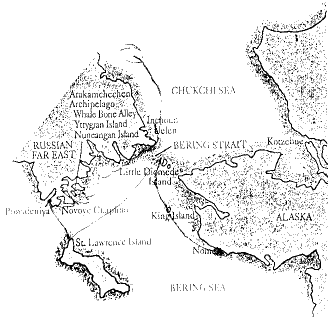
Beringea: Crossroads Of Continents
North American And Eurasian
(Alaska And Russian Far East)
1992
Dear Cha-Wel-Dor-Sue:
 The
idea of visiting Nome and Kotzabue appealed to me and the additional
pleasure of visiting the Russian Far East settled my decision to make
the trip on an old friend, the World Discoverer. Because of the
logistics of the flight to Nome, an overnight in Seattle was
necessary.
The
idea of visiting Nome and Kotzabue appealed to me and the additional
pleasure of visiting the Russian Far East settled my decision to make
the trip on an old friend, the World Discoverer. Because of the
logistics of the flight to Nome, an overnight in Seattle was
necessary.
Two
immediate disappointments occurred. First, in traveling from
Anchorage to Nome on Alaska Airlines, we stopped at Kotzebue for 30
minutes, and all of this time was spent in the waiting room of the
terminal. However, I fully expected to see Kotzebue as it was a
scheduled stop on our itinerary as we explored the Chukchi Sea and
the Arctic Ocean. Unfortunately, the itinerary was changed
unbeknownst to us and our dream of seeing this remote Inuit village
vanished. Secondly, we arrived in Nome just prior to sailing and had
only 25 minutes, using a taxi and at our expense, to see Nome's Main
Street. This city of course was famous at the turn of the century
when there were gold rushes in 1899 and 1900. At that time, more than
20,000 people were there in search of their fortune and by 1911, more
than 60 million dollars in gold had been mined from the Seward
Peninsula beaches, streams, and hills. Nome is also well known today
as a result of the Iditarod Sled Dog Race( a race from Anchorage to
Nome). It was inspired by an episode that occurred in 1925 when a
diphtheria epidemic threatened the town of Nome and some serum was
urgently needed to treat the people. This needed serum was relayed by
dog team from Nenana to Nome and some 20 dog teams raced the medicine
674 miles in 127 hours. Today, this historic event is commemorated
with the well-known famous Iditarod Sled Dog Race. The competition
starts in Anchorage in late February or early March and usually, the
first musher arrives in Nome anywhere from 10 to 12 days
later.
On
our return to Nome for our departure flight, we were whisked to the
airport and had very little opportunity to see much of this
historically fascinating town.
We
left Nome in a rough sea and almost immediately I found myself sorry
that I had chosen to make this trip, as I was almost overcome with
"Mal de Mer". It was my constant companion for the next 48 hours.
During this time, we sailed by King Island and the passengers were
given the opportunity for a Zodiac trip along the cliffs to see the
bird life. It was reported the cliffs were spectacular. Needless to
say, I preferred the supine position in my cabin!
Our
next stop was Gambell, St. Lawrence Island (U.S.A.) and here, I did
go ashore, wandered about the village of 550 souls, and watched some
native dancing. We were told that this dancing is unique in that the
dancer endeavors to act out the locomotion of the animals, ie.
squirrel dance, whale dance, walrus dance, and especially the bird
dance with one's arms playing the role of wings. The accompanying
music is a drum made of stretched walrus stomach struck with a stick
of bone. It is done in a rhythmic fashion and is usually quite loud.
It would have been a long walk from our Zodiac landing over a pebble
stone surface in order to reach the village so I elected to ride with
a small Eskimo boy on his four-wheel All Terrain Vehicle (Honda, and
at a charge of $5 one way). These people are Yupiks and are related
to our Alaskan Eskimo or Alaskan Inuits. These people, who are
Americans, own St. Lawrence Island and today maintain the highest
level of cultural autonomy of all native Alaskans, including the
preservation of their native language. Jacques Cousteau has created a
beautiful film entitled "The Smile of the Walrus" which was filmed at
Gambell, St. Lawrence Island, and which deals with walrus hunting and
the raising of a walrus calf after its mother had been killed during
a hunt. It was most moving to see and the walrus pup was no different
than one of our infants in its need to be mothered.
The
residents of St. Lawrence Island support themselves by hunting the
walrus, whale and seals and raise foxes on "farms" for their fur. The
walrus is highly sought after for its meat is used for food, the hide
for skin boats, the stomachs for Eskimo drums, and the tusks for
carving beautiful ivory pieces. As U.S. citizens they receive food
stamps and Social Security. Their Russian counterparts across the
international Date Line live in Eastern Siberia and these natives are
also supported or subsidized to some extent by Russia. Both nations
recognize the need to preserve the cultural and ethnological identity
of their Eskimos and Reindeer people.
The
next day, we sailed to Providenya, a town of 8,800 people, situated
at the lower end of the Chukchi Peninsula. It was our only "dry
landing" during our entire trip as the remainder of the places that
we visited were remote areas and there were no wharfs. At Providenya,
we saw Russian officials for the first time and from then on, a
Russian representative was aboard our ship to make certain that none
of us jumped ship into their country and that none of their
countrymen got aboard as stowaways. The town is of recent
construction, having been built in 1937, and it was dark, dirty,
dingy and littered with all sorts of abandoned junk. This city was
closed for over 3O years during the Cold War and was only reopened in
June of 1988. We visited a bakery, a brewery, museum, school, and
then witnessed at the Cultural Center some old and new dances as well
as superb performers on the accordion by young, extremely talented
children, two of whom had taken second and third honors in the
Accordion Competition in Moscow! Graduates of the school system in
Providenya may go on to University in Kabarosk, Vladivostok, Moscow
and Leningrad, etc. The town itself was a depressing sight to view
and made more so by the cloudy and misty day. Here, we saw more
Russian faces than anywhere else on our trip.
Our
stop at Arakam Chechen Island was our first opportunity to see a
Walrus' Haulout, a place where walruses gather together on the shore
in fabulous numbers, literally covering the beach and each other! We
viewed the walruses from a cliff in groups of 10 people while keeping
quiet and with minimal movement so as not to disturb them. Some were
swimming in the water with their tusks showing. It is estimated that
40,000 walruses come to rest and feed during August and September
under the protection of the Russian Wildlife Service. Walruses are
not an endangered species. We also noted on the cliff a
nuclear-powered lighthouse. In order to get to the viewing site
entitled a long uphill trek over tundra and was slow going. The
tundra is a very delicate ecology and consists of a subtle natural
landscape of mosses, lichens, fungus and wildflowers. Apparently,
once disturbed or destroyed, it takes a long time for its
recovery.
Our
next stop was on Yttigran Island and this was made in order to enable
us to see "Whalebone Alley". It is a fascinating site and consists of
a long row of skulls of Arctic Bowhead whales covering some 550
meters along the seashore, and are set in the ground in groups or
rows of two and four. They most likely have been of ritual and
religious significance. Long spike-like bones consisting of the lower
jaws of whales are also set up and some look like arcades. I
understand they have been used as tent supports. This site is
considered as one of the most grandiose religious places ever built
by the native people in the Arctic area.
In
order to see one of the major objects of our expedition, it was
necessary to sail North to the Bering Strait between Big Diamede
(USSR) and Little Diamede (USA) Islands. At this point, the Strait is
100 miles long and approximately 50 miles wide and stretches from
Cape Wales on the Alaskan Seward Peninsula to Cape Dreznev on the
Chokohi Peninsula in Eastern Siberia or Russia. By sailing North, we
would encounter ice floes and the prospect of seeing polar bears. The
bears are mostly concentrated in the area of Harolds Island and
especially in the vicinity of Wrangles Island. Ultimately, we reached
a point of 72° 33 minutes North and we were in an ice
concentration of 3 to 4. Zero (0) represents no ice and 10 represents
solid ice and no free water or no "leads". Polar bears swim great
distances but prefer to do their hunting of seals on ice floes. Their
chief diet is that of seals and walruses. The Arctic Circle is
66° 33 minutes North so when we were in the vicinity of Wrangles
Island, we were farther North than we had expected to be and it was
indeed the farthest North than any of the past expeditions had been
able to get to. The ice floes consisted of many broad, flat
aggregations of ice which were very suitable for polar bear
habitation. Several were sighted swimming alongside of our ship but
it was only later in the evening that the real thrill occurred. It
was foggy and misty at night and probably for want of something to
do, the Cruise Director and Expedition Leader decided to provide us
all with a Zodiac ride among the floating ice masses. While we were
cruising along the small bergs, we were surprised to hear a message
from the ship indicating that a giant polar bear was in our midst and
on one of the ice floes. And then, lo and behold, he was there in all
his magnificent glory, a huge beast cavorting on a flat ice mass!
Despite the fog and mist, I tried to capture it with my video camera
using the telephoto lens and most likely it will be too dim to be
seen and probably too shaky to be viewed with comfort.
After
our polar bear experience, we turned Southward and visited the
village of Uelen, which is the largest native community on the
Northeast coast of Chukchi Peninsula and it has a population of 830
people, all Eskimos. They subsist on fish, sea mammals, reindeer, and
from raising foxes on their farms. On the day we visited Uelen, a
real surprise lay in the offing and one entirely unanticipated. We
were scheduled to go ashore and to walk about the village and plans
were made to visit a museum noted for its fabulous ivory carvings and
scrimshaw, the schoolhouse, and then to witness some dances at the
Cultural Center. However, just prior to breakfast, a boatload of
hunters was sighted off our starboard bow, apparently after a killer
whale or Orca. Everyone rushed to the rail to witness the hunt. Shots
were heard, apparently fired by the hunters, and the whale was
killed. It was then harpooned and a colorful buoy attached to it for
later recovery. At the same time, further shots were heard and in the
next 30 minutes or so, four walruses were shot and each one
identified with a tagged buoy. As the expedition leader said, if he'd
had a million dollars to plan this sort of an event, it probably
could not have been brought about, but we just came upon it
spontaneously and were witness to the entire event. Subsequently,
while we were at the village, the walruses were brought ashore and
butchered. After having had our breakfast, we went ashore on our
Zodiacs and trekked about the village with a local guide and one of
the interpreters from our ship. The dances were interesting and were
performed out of doors on a platform in front of the Cultural Center
and accompanied by the usual music with the Eskimo skin drums. At the
point where we boarded our Zodiacs for our return trip to the ship we
watched the skillful carving of these huge sea mammals and it seemed
that virtually every portion of the animal was preserved. It was the
concluding drama of this unanticipated "hunt" and we were fortunate
to be in the right place at the right time!
Not
far South of Uelen is Cape Dreznev and this is the closest point to
the North American Continent, or the most easterly point of the
Eurasian Continent. I climbed up the Cape and had a beautiful view of
the Strait and could see both continents at the same time. On the
250th Anniversary of the discovery of the Cape, Czar Nicholas II
renamed it Cape Dreznev in honor of Captain Dreznev who first
discovered it. Subsequently, Captain James Cook visited this site and
referred to it as the East Cape. It is a striking rocky promontory
projecting itself out into the Bering Sea,. birds were there by the
zillions. There were kittiwakes, thick-billed and common murres,
pelagic cormorants, horned and tufted puffins, and crested auklets.
Never in my life have I seen so many, many birds! The kittiwakes are
white and gray and are so called because of their call or the sounds
they make. The murres are black and white and look like small
penguins when on the roost and they, too, are called murres because
they seem to make a sound like "murrrrrr". The puffins are the
colorful glamor birds and have a large beautiful big and heavy beak.
There were some seagulls that are much like those we have at home.
The auklets were small dark birds that skimmed over the surface of
the water or literally flew over the water and then dove below the
surface. When I first saw them, I described them as small black ducks
but they were not ducks, they were indeed birds.
There
was a lighthouse on the North side of Cape Dreznev and there were
signs of recent habitation with old abandoned houses of wood and
metal construction. There were also many pits that were carefully
built of stone and which may have been storage areas. The usual
collection of whalebones were also present. It is interesting that
archaeologists have found human artifacts here that date back some
two to three and a half thousand years ago. Apparently, the
settlement that was here was removed to other areas by the Russian
government at some time in the past. As I stood fairly high up on the
Cape, I noted a solitary walrus swimming below and also a large gray
whale. The sea at that time was calm and perfect for viewing and,if
one were an Eskimo, for hunting.
We
also visited another small village called Inchoun and this was quite
similar to the others that we had visited. Now, in order to clear
Russian Customs, we had to literally retrace our entire trip back to
Providenya and, in fact, were cleared at a small community called
Novochaplino, which is a short distance from the larger city of
Provadenya. Apparently, there are no other major government
facilities North of this area. Our faces and our passports were
matched and the ship was cleared for our return to America. All the
officials wanted to know was how much money we had left in their
homeland. We had been permitted to buy $3 worth of rubles, brand new
ones, at the rate of one thousand per dollar. We were instructed to
exchange the rubles on our departure but I kept mine as souvenirs. I
spent only $20 and $15 of this was for a wooden model of a walrus and
a small carving on a caribou antler. There is a law which prohibits
the importation of ivory of any kind into this country from abroad
and therefore, any ivory carvings that may have been purchased in
Russia would not be permitted entrance into our country. There were
many beautiful bits of ivory carvings that I would have loved to have
brought home with me but this was out of the question. However, some
of our friends who had some time in either Kotzbue or Nome were able
to buy carved objects and brought them home with them. Apparently,
the law was created to discourage people from shooting walruses for
their ivory alone but it only makes sense to permit an Eskimo to sell
his carvings as a means of support and some perfectly magnificent
carvings today reside in museums and cannot be purchased by a tourist
or traveling individual.
Our
Faculty on this trip, as on previous trips, was a good one and the
principal speakers were superb. There were some young people who were
just getting started in this type of work and were simply feeling
their way along. They didn't add greatly to our enjoyment of the
expedition.
It
is of interest that a Bering Sea International Park is in the process
of development and the idea of establishing a Soviet-American park in
the Bering Strait area was spearheaded by environmental groups
interested in preserving the wildlife in this part of the world. In
1988, the Bering Strait International Park essentially became a
reality when President Reagan and Mikhail Gorbachev expressed their
support of political and scientific cooperation in the Arctic.
Finally, a treaty was signed in 1990 by Bush and Gorbachev
authorizing the new park. The United States contributed 9 million
acres and the Russians generously donated the entire Chukchi
Peninsula of some 15 million acres to the project. Native contacts
and festivals, joint research, and Visa-free travel are planned. It
is a step in the right direction to encourage American and Russian
cooperation in the future. No doubt, ten years from now, this area
will be far more familiar to American tourists than at present and I
am glad that I saw it at the present time when a tourist in this area
is a curiosity among the "Native Peoples" They find us as interesting
as we find them! I had a bit of a feeling that I had when I was among
the first tourists in China in 1979, when that country first opened
its doors to tourists from abroad.
With love,
DAD
or