DAD-O-GRAM
Norwegian Saga
July 1985
Dear Cha-Wel-Dor-Sue:
 It
has been said that "Into each life, a little rain must fall", but
this certainly did not apply to our visit to England (June 1985 -
highest rainfall on record), and to Norway in July (July 1st to July
12th) when it rained nine out of 12 days. In fact, on our fourth day
in Norway, aboard the Midnat Sol, I noted for my DAD-O-GRAM the
following: The less things change, the more they remain the same.
Mist, mist, mist, and rain, rain, and rain had so obscured the views
from the ship that all I remember of the trip, at least so far, is
that of hazy mounds of islands on both the port and starboard sides
of the ship. Part of one day (Molde to Kristiansund) the sun did
appear, and appeared, in fact, no brighter or larger than any view of
it I have ever seen at home. Small fishing villages are seen from
time to time on isolated islands and only the extreme necessity of
survival would ever prompt me to such an existence, especially in the
winter, when the sun disappears for months at a time.
It
has been said that "Into each life, a little rain must fall", but
this certainly did not apply to our visit to England (June 1985 -
highest rainfall on record), and to Norway in July (July 1st to July
12th) when it rained nine out of 12 days. In fact, on our fourth day
in Norway, aboard the Midnat Sol, I noted for my DAD-O-GRAM the
following: The less things change, the more they remain the same.
Mist, mist, mist, and rain, rain, and rain had so obscured the views
from the ship that all I remember of the trip, at least so far, is
that of hazy mounds of islands on both the port and starboard sides
of the ship. Part of one day (Molde to Kristiansund) the sun did
appear, and appeared, in fact, no brighter or larger than any view of
it I have ever seen at home. Small fishing villages are seen from
time to time on isolated islands and only the extreme necessity of
survival would ever prompt me to such an existence, especially in the
winter, when the sun disappears for months at a time.
However,
our spirits were not totally depressed, as we knew that sooner or
later, the sun would indeed shine again, and it did later on and
after we had passed the North Cape. While we were on the North Cape,
the mist and the fog were so dense that if Pat had not had a foghorn,
I am sure I could not have located her whereabouts. We did, indeed,
take some pictures and they will tell the story.
Friends
of ours were on the steamship line one day ahead of us and we were
told that it was a beautiful day on the North Cape and nary a cloud
was to be seen.
Throughout
our travels, we have been subjected to the vicissitudes of the
weather but I must say that by and large, we have been treated rather
fortunately. Had Pat and I each had a walkie-talkie on the North
Cape, we would have had no trouble keeping in touch with each other.
Fortunately, the area is rimmed with a fence for to wander over the
edge would have meant a fall precipitously of almost 1,000
feet.
Our
Norwegian adventure began in Bergen and it is said of this city that
"It stops raining in Bergen more often than anywhere else in the
world." I would add that it could be said of Bergen that "The last
time it rained in Bergen was yesterday", and one could say this every
day of the year. I did read of Bergen that if it rains only once a
day in Bergen, it is considered a "dry day". However, I should add,
that some thirteen or fourteen years ago, my children and I had been
in Bergen and the sun must have shined for at least a brief period of
time for we do recall going up the Funicular and viewing the city
from the highest point on the mountains.
Our
trip was essentially a 12 day, 2,500 mile trip along the west coast
of Norway and around the North Cape to the very border of the Soviet
Union. In traveling these many miles, we stopped at some 32 ports of
call for longer of shorter periods of time depending upon the time
required to load and unload the ship of its cargo and to pick up
transient passengers. These stops afforded us the opportunity to see
how efficient the Norwegians were in their coastal shipping and also
afforded us the opportunity on at least five occasions to take bus
trips, either to see the city visited in depth or to travel from one
fishing village to another. This served to break up the 12 days at
sea, although I must say that the ship was a very sound one and
traveled with very little disturbing motions. The food aboard was
superb and each morning, there was a smorgasbord or buffet type of
breakfast and luncheon. In the evening, there was usually a sit-down
dinner. Perhaps the only disturbing fact for me was the high cost of
a bottle of beer, which was $3.50 per bottle anywhere in
Norway.
Today,
the Scandinavian Air System Airline supplies flights to virtually
every one of the remote areas of Norway and it may be that in the
future, the Norwegian coastal shipping service will be archaic and
everyone will fly to every little hamlet and cove along the coast.
For the moment, at least, we feel that we have been part of history
and our moments on the "Midnight Soul" were memorable. Our
accommodations were more than adequate and the service and facilities
were wonderful. I'll never forget the innumerable fishing villages,
fjords, the occasional glacier, and particularly our visit to the
Lofoton Islands which are the principal fishing areas of northern
Norway.
To
enumerate all of the towns that we visited in their respective order
would not be greatly meaningful to you but I will mention a few of
the highlights. The termination of the trip northbound was in
Kirkenes, the capital of Finnmark. This is the most northerly and
largest of the Norwegian counties or communes, as they are called,
and our trip there will remain one of the highlights of the trip. The
day was indeed a beautiful one and we took the occasion to take a bus
trip to the Soviet border. It seemed strange that we were not
permitted to take a camera within 15 kilometers of the border and for
those of us who have carried a camera all over Russia, it seemed like
an unnecessary precaution, as there are no real fortifications that
could possibly be photographed at this site. It might be of interest
to tell you that Kirkenes is at the same latitude as Point Barrow,
Alaska, the site at which Wiley Post and Will Rogers died in a crash
among the ice floes.
One
of the pleasant aspects of our trip was the constant companionship of
Hal and Edith Pratt of Windsor, CT, friends whom we have known for
some time and whom we met through the Nutmeg Camera Club. Hal is
perhaps one of the finest photographers I have ever met and I was in
a position to observe his artistry.
In
all group travel, a large part of the enjoyment is provided by the
courier or tour guide. In our case, Grete, of German descent, was our
courier, and she announced all events in Norwegian, German, and
English, and with very satisfactory accents. She was concise in her
remarks and provided some additional humor. When I asked her if she
had a degree in linguistics, she replied to the effect that she had
not and that furthermore, she was hired because she spoke only a few
words of Norwegian, English and German and accepted the job in order
to make a living. This was a most masterly understatement!
A
brief comment on some of the cities might be of interest.
Bergen
is the second largest city in Norway and has a very natural harbor
which explains its prominence in commerce and seafaring activity. It
was founded in 1070 by King Olav Kyrre and during the 12th and 13th
centuries, was where the Norwegian kings resided. It was here that
the Hanseatic League conducted their Norwegian activities and
acquired a monopoly of foreign trade. We visited the oldest building
in Bergen, which is the Church of St. Mary, built in the first half
of the 12th century, and in our little city tour, we did pass the
University where my family and I stayed during our visit to Norway
many years ago. We did not take the time to visit "Troldhaugen" the
home of Edvard and Nina Grieg.
We
did spend part of a day in Molde, which has been called "The town of
roses". It was of interest that many plants that really belong to far
warmer climates grow here on the sheltered slopes and in this regard,
it is interesting to note that at no time are any of the ports on the
western coast of Norway ice-bound and this is due to the warming
effects of the Gulf Stream. This is in marked contrast to the ports
in Sweden and Finland which are absolutely ice-bound during the
greater part of the winter.
Trondheim
is Norway's third largest town with a population of 135,000 and is
particularly noted for its Nideros Cathedral. It is the largest
medieval building in Scandinavia. It is believed to have been built
over the tomb of St. Olav and in prereformation times was one of the
major goals of European pilgrims. It apparently has been and was a
shrine for many years and people would traverse tremendous distances
to visit this holy site. Seven kings and three queens of Norway have
been crowned in this cathedral and nine kings and most of the
archbishops lie buried here. Certainly, we saw too little of
Trondheim for me to even comment upon the interests of the city but
on any return visit, I will certainly allot a lot more time as there
was a great deal of interest to see there. During our short visit, we
did visit the Musical History Museum at the Old Ringve Manor and this
is Norway's only museum for musical instruments. It is well worth a
visit.
Tromso
is another very interesting city and represents the largest urban
community in northern Norway. Today, it is an educational center as
well as a trading, shipping an service center, most of which are
based mainly on fisheries, canning, cold storage and refrigerator
plant and processing factories. During the war, Tromso acted for a
short while as the capital of free Norway and it was just off the
coast that on November 12, 1944, the German battleship Tirpitz was
attacked and sunk by British planes. The ship had been under the
observation of Norwegian agents. Tromso is also interesting as it has
been the point of departure for expeditions to the Arctic and Roald
Amundsen's statue stands in a small park there. History has recorded
that the Italian, Umberto Nobile, took off from this general area to
fly with his dirigible to the North Pole. Apparently, an accident
occurred and he and his crew were marooned on some ice floes. Roald
Amundsen, along with 20 of his fellow Norsemen, took off in a French
plane in June of 1928 to render assistance and they were all lost. As
fate would have it, Umberto Nobile and his crew were ultimately
rescued. Lastly, there is a beautiful cathedral there, known as the
"Cathedral of the Arctic". This was well worth a visit and I have
many pictures of this beautiful edifice.
The
last town that I shall briefly mention is Hammerfest which has only
7,500 inhabitants and which is the world's northernmost town, its
exact latitude being 70°, 39 minutes, 48 seconds latitude north
and it is here that the summer day lasts from the 17th of May to the
28th of July and also it is here that darkness lasts from the 21st of
November to the 23rd of January. While we were in this small town, we
visited their Polar Bear Museum and Pat and I joined the Polar Bear
Club of Hammerfest. During the Second World War, the Germans used
Hammerfest as a Naval base and forcibly evacuated all of the
inhabitants and razed the town to the grown. After the war, a
cathedral or Catholic Church was built there largely by German
Catholic volunteers and the mosaic work on the facade, depicting St.
Michael and the Dragon, consists of over 10,000 pieces.
During
the entire trip, I took a great many photographs and in each town,
endeavored to photograph the name of the town, wherever it could be
found. I thought that this would help me in sorting out my slides
after I got home but it was perfectly apparent after a while that the
fishing villages look so much alike that the task was impossible so
that now, I have organized the entire trip in general subjects and
would never attempt to take one along with my slides in the precise
order in which we made our odyssey.
Certainly,
Pat and I can recommend a trip on the Norwegian mail boat, for it
would be a restful, enjoyable, interesting, and, depending upon the
weather, a most beautiful and memorable vacation.
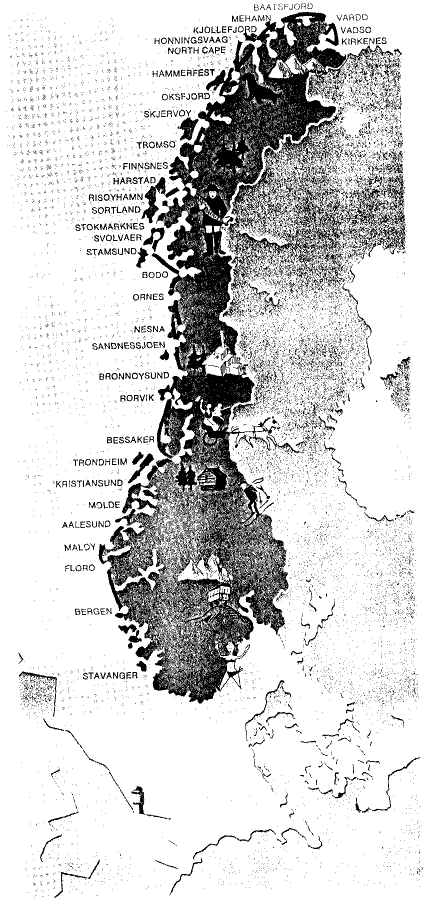
Below
is a map of Norway which included the names of many coastal towns, a
few of which I have mentioned.
Love,
DAD
CEJ/ngb
Return to Charlie's
Web Page
or
E-mail Charlie at
cejjrmd@mac.com