 "He
who knows only his own country is like a man who reads but the first
chapter of a book." (St. Augustine)
"He
who knows only his own country is like a man who reads but the first
chapter of a book." (St. Augustine)
Morocco 1983
Dear Cha-Wel-Dor-Sue,
"He
who knows only his own country is like a man who reads but the first
chapter of a book." (St. Augustine)
In
a further effort to add another chapter in our book of travels, Pat
and I, admittedly both wonderers and wanderers, chose Morocco,
situated in the northwest Maghreb ( northwest Africa.) Morocco is an
interesting country of Islamic background that is an anomaly today; a
country with one foot in a medieval civilization and one in the
twentieth century. The people are largely Berbers, with traditional
Islamic religious virtues which must be matched with western
democratic ideals, and even with the principles of Marxism-Leninism.
Hopefully it's King Hassan II, a friend of the West, will be able to
integrate the "old" and "new", and not repeat the Shah of Iran's
error of "rushing too rapidly into the twentieth century". Morocco
had to be our choice, as Baghdad, Damascus, Shiraz, Isfahan, and
other cities of the Middle East were no longer safe for an American
traveler. Someday, perhaps, there will be a quietude in the Middle
East, and Pat and I can add this area and chapter to our book of
travels.
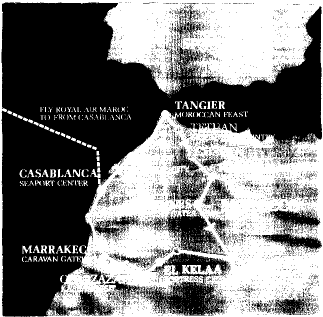
The
enclosed map provides the itinerary of our tour and should be of help
as you travel with us in our DAD-O-GRAM.
The
area now known as Morocco was long occupied by the "blue-eyed"
Berbers, whose ethnic origins are unknown. There are, incidentally,
traces of neolithic man in the area around Casablanca and the
Moroccan area had been visited by the Phoenicians, the Carthagenians,
Vandals, and the Byzantians. It was, however, only after the arrival
of the Arabs in the eighth century (Moulay Idriss I), that the real
history of Morocco began. Since then, there has been a succession of
dynasties, each succeeding the other, either through claims of direct
descent from the Prophet Mohammed, or through "power rule" based upon
murder, poisonings and assassinations, as feudal Islamic barons
fought each other to represent the faith. Briefly, the dynasties are
as follows: Idriss (788 A.D.), Berbers (Berghouata 950-1100 A.D.),
Almoravides (1100-1150 A.D.), Almohades (Unitarians 1150-1213 A.D.),
Merinids (1215-1500 A.D.), Sasdis (1500-1600 A.D.), and the present
Alaouete dynasty, of which the late Mohammed V and his son, the
present King, Ilassan II, is the present heir.
Though
our visit only entailed two weeks, it did provide a far better
introduction to the country, its geography, topography, economy,
political and religious history, and the nature of its peoples
(Berbers, Arabs, and Saharans) than any series of books could
possibly provide. From my brief period of observation in Morocco I
came to certain inescapable conclusions. The wants, at least of the
rural Moroccans, are simple and can be summarized as follows: (A) All
need an abode, usually clustered in settlements, and differ according
to the people and areas involved. The Berbers and Arabs live in brick
huts, the Saharans in adobe huts, and the Bedouin nomads in tents
woven of black goat hair. (B) All seem to have some sort of
transportation: Camels for the Saharans, and mules and donkeys for
the Berbers and Arabs. Horses are usually seen only in the northern
areas. (C) A plot of land, and this is usually apart from the
village, which is used to grow their fruit, vegetables, grains, and
if possible, date palm trees. (D) A smaller or larger flock of
animals, usually goats, sheep and occasionally some cattle. Once a
year, each Muslim family sacrifices an animal and retains one-third
for its own use and donates the other two thirds to the needy. It is
part of the Islamic tradition of concern for one's fellow man and is
sometimes called the Sixth Pillar of Islam. There is virtually no
entertainment in the form of radio, TV, cinema and the like, and
rural electrification is rarely seen. However, the people seem happy,
contented, relaxed, and welcome visitors with a smile and with no
apparent evidence of envy.
In
contrast with conditions in the country, life in the city is quite
different. Most people we met were trades people, making and selling
their wares and handicrafts in the souks or bazaars, and these
commercial activities take place in the medinas, or cities. Some city
dwellers work in government administration, some in industry in the
larger cities, and some make a living by entertainment. In the large
central square in Marrakesh, called the Diemma el Fna, snake
charmers, acrobats, singing and dancing groups (folklore),fortune
tellers, scribes, mendicants or beggars, water sellers, etc., all
abound and the general effect is that of a ten ring circus! Pick
pockets are also on the loose and one of our group was separated in
an instant from his wallet!.
The
country is overwhelmingly Muslim, with a few enclaves of Jews who
live in Mellahs, and a fewer number of Christians, both groups of
which are usually confined to the congested cities. Few churches and
synagogues are seen, whereas mosques usually, though not invariably
topped with minarets, are literally everywhere. At this point a few
comments on the Islamic religion may be of interest to
you.
There
are five pillars of Islam. (A) The Declaration of Faith, a simple act
of saying "Allah is the greatest, and there is no other God than
Allah, and Mohammed is his messenger or prophet". It is said three
times in the presence of three Muslim witnesses and no clergymen, or
service of baptism or communion is involved. (B) A promise to
practice alms giving. (C) A promise to pray, usually five times a
day, before sunrise, at noon, at mid day, after sunset, and late at
night. It is usually, though not necessarily, done in a mosque, and
after the ablutions, or cleansing of the body. One must face east or
look toward Mecca and Medina, and the ritual usually includes
reciting some verses from the Koran. One also uses gestures in this
ritual and prostrates oneself with one's forehead touching the prayer
carpet. Only the Friday noon prayer service is lengthy in character
and involves the presence of a religious leader or Inman. The call of
prayer is uttered by a muezzim from the top of the minaret (recorded
devices are frequently used today), and the following words are
uttered: (freely translated)
"Allah is the greatest.
There is only one God, Allah, and Muhammad is his messenger or prophet.
Come to prayer.
Come to salvation.
Prayer is more restful than sleep.
There is no other God but Allah and Muhammad is his prophet
Allah is most high and the greatest."
(D) A promise to observe Ramedan, a month long period of fast, in which one may not eat, drink, or engage in sexual intercourse during the day. (E) An effort to make a Hajj or pilgrimage to Mecca, and if this is not possible, to observe a Moussem at the nearest holy shrine once a year.
A
sixth pillar might be added, that of the yearly sacrifice of an
animal and its sharing with others.
When
one Arab meets another, he is apt to say "Allabu Akbar!" "God is most
great". It has many shades of meaning: in war a rallying cry, in
peace a prayer, and at any time a sign of fraternal good will. Islam
means "surrender or submission to the will of Allah, in whose eyes
all men are equal, and all men are brothers". The word Moslem in
Arabic means "one who submits". The Moslem faith recognizes Adam,
Noah, Abraham, Moses, and Jesus as humans and prophets, not divine,
but also claims that Mohammed's role was the all important one and
that was to bring the final revelation to man in the words of the
Koran. This book reminds us that "our abode is transitory and our
life a loan."
Moroccans
are Sunnis (from Sunnah, meaning "custom and law") and are orthodox
in doctrine. They are followers of Muawiya, an Arab governor of
Syria, who moved the seat of Islam from pious Medina to Damascus, and
who had Ali, Mohammed's son-in-law, murdered, and his head hung on a
parapet for all to see. In contrast, the Shiites, or Shiahs,are
partisans or followers of Ali, Muhammad's son-in-law, and whose
leaders are venerated as divinely guided. Schisms,developed as a
result of the murder of Ali and have remained to this day The present
Iran-Iraq war, is one manifestation of this cleft in loyalty. Both
the Sunnis and the Shiahs are implacable enemies of Bahaism, whose
founder Bahaullah predicted that another prophet "Bab-the-Gate''
would appear and would gather the diverse peoples and nations of the
world together and establish the unity of mankind as promised in all
the Holy Scriptures. His insistence, however, that Mohammed was
simply another one in the long line of prophets, is the very reason
Khomenei of Iran has declared war on the Bahais. For me, the basic
ethical tenets of Bahaism are the most rational yet created by man
and, furthermore, they also incorporate the concept of a world
government. It is an intellectual's religion and was designed to
bring the Christian and Hindu, Muslim and Jew, Z.oroastrian and
Buddhist together as children of one God. Unfortunately, the creation
or the promise of another prophet is it's only defect or Achilles
heel, and until it can divorce its ethical principles from the
concept of a new messiah, it will be resisted by all formal
religions.
Our
travels began in Casablanca, the largest city in Morocco and its'
commercial center. This city is westernized to a great extent and due
largely to the French influence during the French Protectorate
(1912-1956). One can wisely spend less time here than elsewhere in
Morocco, as it is not unique and is not one of the Imperial Cities,
(Rabat, Fez, Meknes, and Marrakesh).
Rabat,
the capitol of Morocco, was our next stop, and it is indeed a
beautiful city with many magnificent gardens, including among them
the garden of the King's Palace. Unfortunately, the palace was not
open to visitors. The city also includes the recently built beautiful
Mohammed V's tomb or mausoleum.
Tangiers
was our next stop, and is perhaps the most frequently visited city in
Morocco. It lies just nine miles south of the "Rock" across the
straits of Gibraltar from Spain. It is known for its Casbah and
Souks, and is something of an international city, having enjoyed an
international protectorate for many years. During this period of
time, it was exposed to many European influences but particularly
those of the French, of Spain, and France. We stayed at the Almohades
Hotel, which is situated on the Mediterranean shore and fronts upon a
beautiful beach. Incidentally, the finest beaches in Morocco are on
the Atlantic side and perhaps the best known is Agadir.
The
drive from Tangiers through Tetuan and Cechaouen and Quezzane to Fez
was a most beautiful and memorable one, taking us through the Rif
mountains and revealing for us the remarkable development in
agriculture which the Moroccans have achieved in this area. Aside
from the export of phosphates, which are mined in the south, and the
export of finished leather products, the grains and produce exported
accounted for a large part of Morocco's gross national
product.
Fez
is the oldest of the Imperial Cities and was founded in 808 by Idriss
II. It is the cultural and intellectual center of Morocco and the
local intelligentsia, the Fassi, are very proud of their city and
heritage and consider themselves as special as any Florentine Prince
or any Boston Brahmin. The city is so beautiful that one historian
remarked "Oh Fez! All the beauties of the earth are to be found in
thee". Fez is the "Mecca' of the west, and the "Athens" of Eastern
Islam. Its University, Karaween, is as old as the Al Azbar in Cairo
and dates from the ninth century. There is so much to see in Fez that
it would take another DAD-O-GRAM to mention only a few of the many
magnificent mosques, palaces, Medersas (madrasahs or religious
schools), gates, etc. It is surely a must stop on any trip to
Morocco.
Meknes
is near Fez, and also an Imperial City. It was often the rival of
Fez. Sultan Moulay Ismail, one of the founders of the Alaouete
dynasty, endeavored to make it the Versailles of Morocco and almost
succeeded. The Bab Mansour gate with its beautiful arabesque designs
is one of the most photographed gates in all of Morocco. There is a
large ten acre pool in Meknes and stalls for 12,000 horses and
granaries as big as cathedrals with silos where 20,000 prisoners and
slaves were locked up. This will give `you some small idea of the
grandiose ideas that were conceived by Sultan Moulay Ismail to make
Meknes the greatest city in Islam. Meknes is also a must for any
visitor.
Nearby
and only a short distance from Meknes is Moulay Idriss, situated on
the peak of a small mountain top. This small town contains the tomb
of the founder of the first Arab dynasty to rule Morocco (Moulay
Idriss I).Also a short drive from Meknes is Volubilis, a superbly
well preserved and partially restored Roman capitol. Its remarkable
mosaics are better preserved than those of Pompeii or any others that
I have seen. The Triumphal Arch and the Basilica are particularly
beautiful and testify eloquently to the engineering and architectural
skill of the Romans.
After
leaving Fez, we drove over the middle Atlas mountains to Erfoud in
the Sahara. Suddenly the only green areas were those of the oases
seen along the almost dry river beds. It was here that we met the
Saharans whose women dress in black clothing, and we also met many
Bedouins or nomads who live in black tents made of goat hair and
whose lives must be very similar to those of our gypsies. Our real
purpose in coming to this area was to walk barefoot in the sands of
the Sahara and to watch the sun rise over the dunes as we faced east
and Mecca. To get there we were up at 4 o'clock in the morning and
drove some 26 miles in a British Rover to wait disappointedly for the
sun to rise. Unfortunately, a heavy cloud cover concealed the sun's
rising and later a few drops of rain actually fell in the
desert!
In
order to get to Marrakesh we drove back over the High Atlas mountains
crossing the pass at a height of 7,125 feet. Some of the mountain
peaks in this area reach over 14,000 feet. Its ruggedness matched
anything we have seen in our Rockies and there were many switch
backs, U-turns and roads without any guard rails whatsoever. It made
one hold one's breath and look away from the precipitous cliffs. We
overnighted at El Kelaa and the next day drove to Quazazate and then
on to Marrakesh.
Marrakesh
is the second oldest city in Morocco and known as the "Pearl of the
South". It is situated in the plain of Haouz between the High Atlas
snow capped mountains to the east and the Sahara to the south. It is
the great city of the Berbers and has preserved the pure medieval
structures of the period of its foundation. The Koutoubia mosque, the
Ben Youssef Medersa, the Place Djemaa el Fna, the Saaidis tombs, are
only a few of the many interesting sites to see. While in Marrakesh
we were housed in the most famous and beautiful hotel in all of
Morocco, and Winston Churchill's favorite, the Hotel Mamounnia.
Marrakesh is surrounded by ramparts or a wall some two and a half
miles long with a crenelated top and some twenty entrance gates.
While in Marrakesh we made a trip to the outskirts to see a
"Fantasia" or demonstration of Berber horsemanship. A dozen or more
charged full speed ahead on beautiful mounts firing their muskets in
the air, like a cavalry charge. We had lunch in Berber tents on
oriental rugs and enjoyed cous cous, chicken Tagine, pastries, and
mint tea, all of which are favorites of the Moroccans.
The
dress of the Moroccans is interesting and quite uniform. The men wore
jellabas with hoods and the women wore cloth clothing of various
kinds. Many of the women were veiled or kept their face covered with
head pieces. The color and design of the dress was frequently helpful
in identifying the area from which they came. The dress of the Arabs
was distinct from that of the Berbers and from that of the
Saharans.
Should
one want to visit Morocco, I would recommend reading Faith Mellen
Wilcox's book entitled "In Morocco". She opens her narrative with the
dilemma facing modern Morocco today, and in fact, all Muslim
countries. No humanism born of the Renaissance came to modify the
rigid scholasticism of religion and learning. No Reformation or Age
of Enlightenment eroded the absolute theocratic power of the Sultan,
who was both Pope and Emperor in one. The Sultan's power was absolute
and no one entertained the thought of the consent of the governed.
While dynasty succeeded dynasty in Morocco, things have only changed
since the country won its independence in 1956 and Mohammed V was
recalled from exile in Madagascar to serve as its new King. He died
in 1961 after an anesthetic accident from a relatively minor
operation, and was succeeded by his son Hassan II. Today, there is an
elected assembly and there is representative government. The
governors of each province, however, are appointed by the King. No
one, so far as we could determine at present entertains any thought
of abolishing the Constitutional Monarchy. Labor movements exist and
we were there on May Day and observed some marching in Casablanca.
The labor movement appears to be socialistic in nature and not
dictated by the tenets of Marxist-Leninism.
Morocco
is a friend of the U.S.A. and, in fact, proudly reminds its visitors
that it was the first government in the world to recognize the United
States of America and our President George Washington.
Fortunately
we took two weeks to see Morocco, for if we had not, I would have
been reminded of a recent statement that I have read on traveling.
"There is nothing more fruitless than the drunkenness of kilometers
and the lightning flash crossing of continents. Prisoners of our own
speed, of the noise of our busses and cars, we isolate ourselves from
the countries we visit as surely as if we looked at them through the
glass of museum cases." Now that I have retired, perhaps it will be
possible for Pat and I to travel a little more leisurely and drink a
little more heavily of the delights of our trips abroad.
Winston
Churchill, in an effort to save Great Britain, promised "Blood, sweat
and tears", and Jesus, as one of the basic tenets of Christianity,
preached that one should turn one's cheek and not resist violence.
Mohammed, on the other hand, was so sure of himself and of his
divinely inspired rules, that he set out to convert the rest of the
world to his faith. In fact, he almost succeeded in doing so for the
Islamic empire was the second largest known to civilization, only
being exceeded by that of the Mongols that extended from China to
Russia. It is no wonder that he succeeded because his soldiers shared
with him the spoils of each victory and he promised his followers
that if they died protecting the faith, that they would spend the
rest of their lives in "Paradise" When I asked what "Paradise" meant
to a Muslim, I was always told that it was probably something like a
dreamy state or a mystical experience, in which all of one's wants
would be met. They would be welcomed into their 'Heaven' with a feast
of 3,000 courses, each giving one an appetite for the next. There
would be 80,000 or more servants for each loyal Mu.slim and some 72
wives, all of whom would be virgins. One would never feel over 30
years of age and. would feel as fit as a fiddle in the morning, even
after the wildest of parties. How could any young man raised on the
Koran resist such promises?
With Love,
DAD
CEJ/ngb
or